
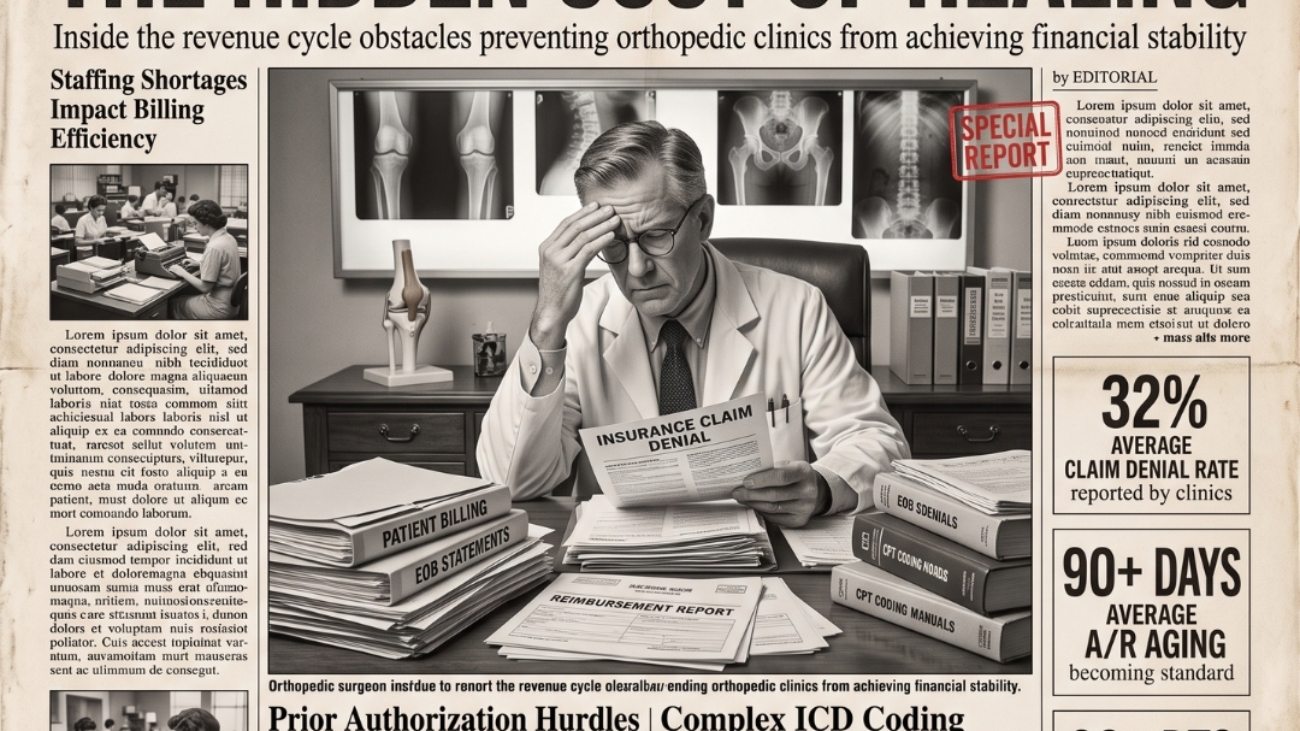
Top Revenue Cycle Challenges Faced by Orthopedic Clinics

Top Revenue Cycle Challenges Faced by Orthopedic Clinics

Orthopedic practices face a number of revenue cycle challenges due to the complexity of their procedures, surgeries, imaging services and lengthy treatment cycles. Coding issues, denials of claims, delays in prior authorization and other issues can directly impact cash flow and reimbursements. Orthopedic practices can benefit from specialized Revenue Cycle Management (RCM) processes to reduce revenue leakage, improve operational efficiency and maintain financial stability. 

Complex Coding and Documentation Requirements

Orthopedic practices provide a wide range of procedures, from treating fractures to performing joint replacement surgeries. Each procedure must be carefully coded and documented in detail. Wrong coding or missing documentation can result in a denied claim or a delay in payment.

Given the common use of modifiers, bundled procedures, and surgical packages in orthopedic billing, accuracy in coding is critical. But regular coder training and detailed documentation review can significantly reduce errors and improve reimbursement rates. 

High Claim Denial Rates 

Claim denials continue to be one of the biggest challenges for orthopedic clinics. Denials can occur due to coding inaccuracies, incomplete patient information, lack of medical necessity documentation, or missing authorizations. 

Unfounded denials add to administrative work and delay payments. Proactive denial management process, denial trend analysis and issue correction prior to claim submission can help improve first pass claim acceptance rates

Prior Authorization Delays 

A lot of orthopedic procedures, advanced imaging services and surgeries need prior authorization from insurance providers. Getting approvals is a long process and often holds up treatment for the patient.

Claims rejected and revenue lost for lack of proper authorization. Automated authorization workflows and dedicated authorization teams can help clinics streamline this process and avoid reimbursement delays.

Insurance Verification Challenges 

Verification is an ongoing challenge because insurance coverage and benefits change frequently. Failure to confirm eligibility prior to appointments may result in claim denials and unexpected patient balance bills.

Real-time insurance verification systems help orthopedic clinics to verify coverage, determine patient financial responsibility, and reduce claim-related problems before service is provided

Managing Surgical Billing Complexity 

Orthopedic surgeries have numerous billing components which include surgeon fees, implants, anesthesia and post operative care. Coordinating these billing elements can be difficult to get right.

Surgical billing errors can result in underpayments, delayed reimbursements and compliance issues. Accurate payment for surgical services is facilitated by robust billing workflows and detailed documentation.

Delayed Payments and Cash Flow Issues 

Financial health of orthopedic practices: impact of delayed reimbursements. Common causes of cash flow disruptions include slow claim processing, payer disputes and incomplete claims.

Efficient accounts receivable processing, timely claim follow-up and automated billing systems allow for rapid collection and financial stability.

Compliance and Regulatory Challenges

Orthopedic practices need to keep up with payer guideline changes, coding standards, and healthcare regulations. Non-compliance can lead to audits, penalties and lost revenue.

Regular compliance audits, staff education, and updated billing systems allow practices to remain compliant while minimizing operational risks.

Conclusion

Revenue cycle issues can have a significant impact on the financial performance of orthopedic clinics. Specialized attention is needed for issues such as coding complexity, denials of claims, delays in prior authorization, and compliance requirements. By implementing effective RCM strategies, leveraging technology, and working with experienced billing partners, orthopedic clinics can enhance cash flow, minimize denials, and dedicate more attention to providing quality patient care. 

Frequently Asked Questions (FAQs)

1. Why is revenue cycle management important for orthopedic clinics?

Revenue Cycle Management ensures accurate billing, timely reimbursements, reduced denials, and improved financial performance.

2. What causes claim denials in orthopedic practices?

Common reasons include coding errors, missing documentation, lack of prior authorization, and insurance eligibility issues.

3. Why is prior authorization important in orthopedics?

Many orthopedic procedures require insurance approval before treatment. Missing authorizations can lead to claim denials.

4. How can orthopedic clinics reduce claim denials?

Clinics can reduce denials through accurate coding, complete documentation, eligibility verification, and proactive denial management.

5. How does outsourcing orthopedic medical billing help?

Outsourcing helps improve billing accuracy, reduce administrative burden, accelerate reimbursements, and optimize overall revenue cycle performance.

Business professionals analyzing data dashboards and performance reports to improve operational efficiency.

How Data-Driven Decisions Improve Business Efficiency

In the competitive business landscape of today, companies depend on accurate information to make decisions that are faster and smarter. Data-driven decision making has become a key strategy to improve business efficiency, productivity, and profitability. Instead of working with assumptions or guesswork companies use data, analytics and insights in real-time to drive operations and strategic planning.

Data-driven decisions help organizations understand customer behavior, track performance, optimize processes, reduce operational costs and find new business opportunities. Whether it’s a small business or a large enterprise, data can be leveraged effectively to make informed decisions that help the company improve its overall efficiency and grow in the long run. 

Improves Operational Efficiency

Operational efficiency is among the biggest benefits of data-driven decisions. Companies generate massive amounts of data every day through sales, customer interactions, marketing campaigns, inventory systems, and employee performance tracking.

Organizations can use this data to diagnose operational bottlenecks, decrease delays, and enhance workflow management. Companies can track performance in real-time and quickly adapt to boost productivity and resource utilization.

Operational efficiency can help businesses to save time, cut down on waste, and increase overall business performance. 

Supports Better Decision-Making

Companies can use data-driven strategies to make decisions based on facts instead of assumptions. Accurate business data provides valuable insights into market trends, customer preferences, financial performance and operational challenges.

This information can help managers and business leaders make better decisions about pricing, marketing, staffing, inventory management and expansion plans. “Good data reduces uncertainty and gives confidence in your business strategy.

Improved decisions lead to improved business results and better long-term planning. 

Enhances Customer Understanding

Understanding customer behavior is the key to business growth. Data analytics helps organizations analyze customer preferences, buying behaviors, feedback, and engagement levels.

Businesses can use this information to personalize products, improve customer support, and create targeted marketing campaigns. Customer-centric strategies increase satisfaction, loyalty and retention.

Understanding customer needs enables companies to provide better experiences and build stronger relationships.

Improves Employee Productivity

Data-driven decisions can help businesses identify unnecessary costs, and get better at managing costs. But by analyzing financial and operational data, companies can optimize resource allocation and reduce waste.

For example, businesses can use it to monitor inventory levels to prevent overstocking, track employee productivity, and optimize supply chain management. Automation and analytics tools also cut down on manual labor and administrative costs.

Cost optimization improves profitability without compromising the quality of operations. 

Strengthens Marketing Strategies

Marketing campaigns are more effective as data is used to learn about audience behavior and campaign performance. Analytics tools help you track website traffic, customer engagement, conversion rates and advertising performance.

This data can be used by companies to refine targeting, optimize budgets and build personalized marketing strategies. Data-driven marketing is helping to boost customer acquisition efforts and improve ROI.

Businesses can also see what marketing channels are most effective. 

Supports Risk Management

Operations, finance, competition and market change are areas where every company has risks. Data analytics allows companies to detect potential risks early and make preventive decisions.

Predictive analytics can help you to anticipate market trends, customer behavior and operational challenges before they become big problems. Accurate data insights allow businesses to plan strategies and reduce uncertainties better.

Effective risk management is supported by real-time business intelligence. 

Encourages Innovation and Growth

Data-driven companies are better positioned to discover new opportunities and respond to shifts in market demand. Analytics can help organizations identify trends in customers, product performance and market gaps.

Companies can use these insights to improve their products, launch new services and develop new business strategies. Data-driven innovation helps companies to stay competitive and achieve sustainable growth.

Data-driven organizations can respond faster to industry changes and customer expectations.

Importance of Business Intelligence Tools

Today companies use Business Intelligence (BI) tools that collect, analyze and visualize data. Platforms such as Power BI, Tableau, Google Analytics and CRM dashboards help organizations make faster and more accurate decisions.

The tools present reports, dashboards and performance metrics that make data analysis easier and strategic planning easier. Business intelligence systems improve organizational efficiency and cross-departmental visibility. 

Conclusion

The ability to make data-driven decisions has been a crucial factor in boosting business efficiency and ensuring long-term success. Analytics, automation and business intelligence tools can help organizations run more efficiently, lower costs, better understand customers and make smarter strategic decisions.

“Companies that rely on data they can trust can respond more quickly to market changes, increase productivity and create stronger growth opportunities. Data is one of the most valuable assets for building efficient and competitive businesses in today’s digital world. 

FAQs

1. What are data-driven decisions?

Data-driven decisions are business decisions made using data analysis, insights, and measurable information instead of assumptions.

2. How do data-driven decisions improve business efficiency?

They help optimize operations, reduce costs, improve productivity, and support better strategic planning.

3. Why is data analytics important for businesses?

Data analytics helps businesses understand customer behavior, monitor performance, identify trends, and improve decision-making.

4. Which tools are used for data-driven business analysis?

Popular tools include Power BI, Tableau, Google Analytics, CRM systems, and Excel dashboards.

5. Can small businesses benefit from data-driven strategies?

Yes, small businesses can use data to improve operations, marketing, customer service, and overall business growth.

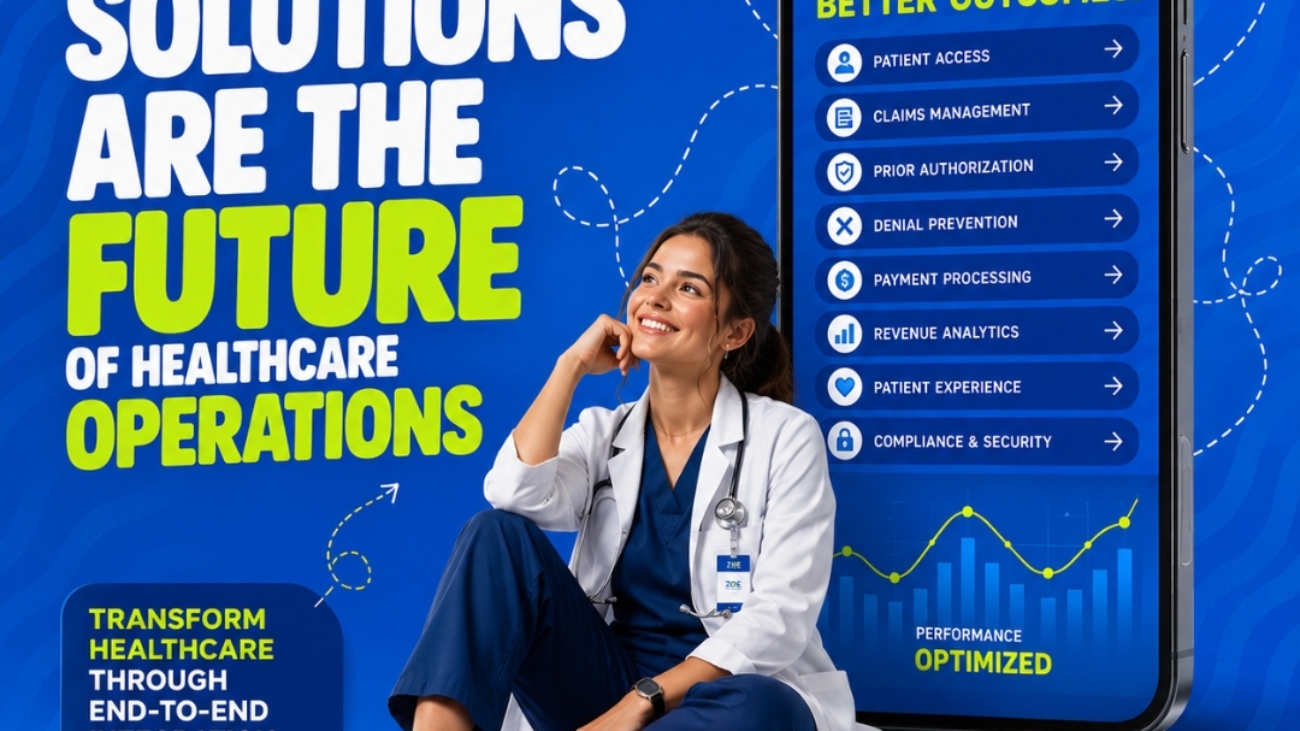
Healthcare professionals using integrated digital healthcare systems to manage patient care and hospital operations efficiently.

Why End-to-End Solutions Are the Future of Healthcare Operations

Patient demands are increasing, administrative workloads are growing, regulations are changing and digital technologies are being adopted at a rapid pace – all of which is making healthcare operations more and more complex. Communication breakdowns, delays, billing errors, and operational inefficiencies are often the result of isolated legacy systems. That’s why end-to-end healthcare solutions are the future of healthcare operations.

End-to-end solutions combine a range of healthcare functions into one integrated system, such as patient registration, appointment scheduling, billing, medical records, communication, insurance processing, analytics and reporting. Such integrated platforms help healthcare providers improve efficiency, reduce manual work, enhance patient experience and make faster decisions. In this blog, we will talk about the reasons why end-to-end solutions are transforming healthcare operations and the future of the healthcare industry. 

Improved Operational Efficiency

One of the biggest advantages of end-to-end healthcare solutions is better operational efficiency. Every day, healthcare organizations manage massive amounts of patient data, appointments, billing processes, and administrative tasks. Disconnected systems across different departments slow down and complicate workflows.

Integrated end-to-end systems link all operations in one platform, reducing duplication of work and increasing coordination between departments. This enables healthcare providers to perform the tasks faster, cut down delays and increase overall productivity.

Automation is another aspect of these systems, reducing manual paperwork and routine administrative tasks, allowing staff to spend more time with patients. 

Better Patient Experience

Today’s patients want faster services, easy communication, digital access and transparent healthcare processes. End-to-end healthcare solutions ease the patient journey by reducing the difficulty of appointments, access to digital records, billing, and communication.

Patients can schedule appointments online, receive automated reminders, get reports in digital formats, and communicate with healthcare providers more easily. This offers a better and more convenient healthcare experience.

Integrated systems can also cut down on waiting times and improve care coordination, leading to increased patient satisfaction and trust. 

Seamless Data Management and Communication

Accurate patient information is critical for healthcare providers to diagnose, treat and bill patients. End-to-end systems mean that patient data is centralized and available in real time in departments.

Doctors, nurses, billing teams, laboratories and administrative staff all have access to the same current information, immediately. This improves communication, reduces data errors and enables faster decision making.

Additionally, centralized systems reduce the risk of lost records, duplicate entries, and miscommunication between departments. 

Enhanced Revenue Cycle Management

Revenue Cycle Management (RCM) is one of the most critical areas in healthcare operations. End-to-end healthcare solutions combine billing and coding, insurance verification, claims processing and payment tracking into one workflow.

That means fewer billing errors, faster reimbursements, fewer claim denials and improved cash flow. Automated RCM systems also enable healthcare providers to better monitor financial performance.

By streamlining financial operations, healthcare organizations can improve profitability and maintain better financial stability. 

Support for Digital Healthcare Transformation

The healthcare industry is rapidly moving towards digital transformation and end to end solutions play a major role in this transition. Telemedicine, cloud-based systems, AI-driven automation, and remote patient monitoring technologies are more efficient when combined into one connected platform.

End-to-end systems improve access, communications and operational management for digital healthcare services. Connected technology enables healthcare organizations to respond more quickly to changing patient expectations and industry needs. 

Better Decision-Making Through Analytics

Today’s healthcare systems generate massive amounts of operational and clinical data. End-to-end healthcare solutions offer analytics and reporting tools to enable organizations to track performance, patient trends, financial data and operational efficiency.

Healthcare managers can leverage this data to recognize bottlenecks, enhance staffing, optimize resources and make smart business decisions. Real-time dashboards and predictive analytics help healthcare providers respond more quickly to operational issues.

Data-driven decision making improves patient outcomes and organizational performance. 

Reduced Costs and Resource Optimization

Disconnected systems often add to operational costs through duplication of effort, inefficiencies and delays in communication. End-to-end healthcare solutions automate workflows, improve resource utilization and reduce administrative burdens, lowering costs.

Healthcare providers can more effectively optimize staffing, inventory management, scheduling, and billing processes. This increases productivity and reduces unnecessary operational costs.

Optimizing costs enables healthcare organizations to dedicate more resources to the improvement of patient care and medical technologies. 

Improved Compliance and Data Security

Healthcare organizations have strict rules about patient privacy, billing, and data security. Standardized workflows and thorough record keeping in end-to-end healthcare systems improve compliance.

The integrated systems of today also include advanced cybersecurity features such as encryption, access control, and secure cloud storage. This helps safeguard sensitive patient information and reduces the risk of data breaches.

To maintain patient trust and avoid legal trouble, robust compliance and data security are essential. 

Conclusion 

End-to-end solutions are the future of healthcare operations, streamlining complex processes, improving efficiency and patient care, and enabling digital transformation. By integrating healthcare functions into one connected platform, healthcare providers can reduce errors, improve communication, optimize resources and make better decisions.

Looking ahead, organizations that take a comprehensive approach to healthcare will be better positioned to meet the rising needs of patients, operational challenges and to efficiently deliver quality healthcare in an industry that is constantly evolving. 

FAQs

1. What are end-to-end healthcare solutions?

End-to-end healthcare solutions are integrated systems that manage multiple healthcare operations such as appointments, billing, patient records, communication, and reporting in one platform.

2. How do end-to-end solutions improve healthcare operations?

They improve efficiency, reduce manual work, streamline communication, and support faster decision-making.

3. Why are integrated healthcare systems important?

Integrated systems improve data sharing, reduce errors, enhance patient care, and simplify workflow management.

4. How do end-to-end solutions help Revenue Cycle Management?

They automate billing, claims processing, insurance verification, and payment tracking to improve cash flow and reduce denials.

5. Are end-to-end healthcare systems secure?

Yes, modern systems use advanced security features such as encryption, secure cloud storage, and access controls to protect patient data.