
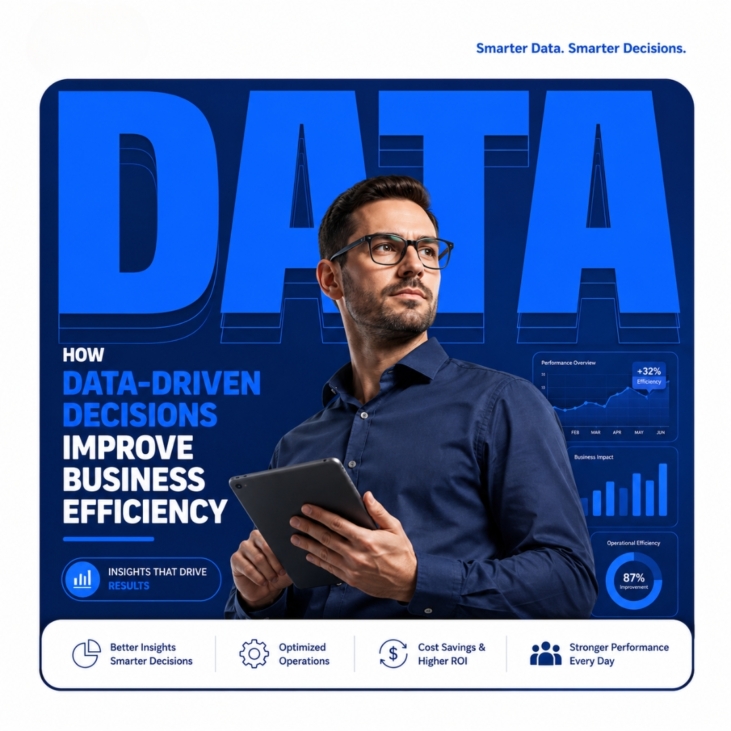
In the competitive business landscape of today, companies depend on accurate information to make decisions that are faster and smarter. Data-driven decision making has become a key strategy to improve business efficiency, productivity, and profitability. Instead of working with assumptions or guesswork companies use data, analytics and insights in real-time to drive operations and strategic planning.
Data-driven decisions help organizations understand customer behavior, track performance, optimize processes, reduce operational costs and find new business opportunities. Whether it’s a small business or a large enterprise, data can be leveraged effectively to make informed decisions that help the company improve its overall efficiency and grow in the long run.
Improves Operational Efficiency
Operational efficiency is among the biggest benefits of data-driven decisions. Companies generate massive amounts of data every day through sales, customer interactions, marketing campaigns, inventory systems, and employee performance tracking.
Organizations can use this data to diagnose operational bottlenecks, decrease delays, and enhance workflow management. Companies can track performance in real-time and quickly adapt to boost productivity and resource utilization.
Operational efficiency can help businesses to save time, cut down on waste, and increase overall business performance.
Supports Better Decision-Making
Companies can use data-driven strategies to make decisions based on facts instead of assumptions. Accurate business data provides valuable insights into market trends, customer preferences, financial performance and operational challenges.
This information can help managers and business leaders make better decisions about pricing, marketing, staffing, inventory management and expansion plans. “Good data reduces uncertainty and gives confidence in your business strategy.
Improved decisions lead to improved business results and better long-term planning.
Enhances Customer Understanding
Understanding customer behavior is the key to business growth. Data analytics helps organizations analyze customer preferences, buying behaviors, feedback, and engagement levels.
Businesses can use this information to personalize products, improve customer support, and create targeted marketing campaigns. Customer-centric strategies increase satisfaction, loyalty and retention.
Understanding customer needs enables companies to provide better experiences and build stronger relationships.
Improves Employee Productivity
Data-driven decisions can help businesses identify unnecessary costs, and get better at managing costs. But by analyzing financial and operational data, companies can optimize resource allocation and reduce waste.
For example, businesses can use it to monitor inventory levels to prevent overstocking, track employee productivity, and optimize supply chain management. Automation and analytics tools also cut down on manual labor and administrative costs.
Cost optimization improves profitability without compromising the quality of operations.
Strengthens Marketing Strategies
Marketing campaigns are more effective as data is used to learn about audience behavior and campaign performance. Analytics tools help you track website traffic, customer engagement, conversion rates and advertising performance.
This data can be used by companies to refine targeting, optimize budgets and build personalized marketing strategies. Data-driven marketing is helping to boost customer acquisition efforts and improve ROI.
Businesses can also see what marketing channels are most effective.
Supports Risk Management
Operations, finance, competition and market change are areas where every company has risks. Data analytics allows companies to detect potential risks early and make preventive decisions.
Predictive analytics can help you to anticipate market trends, customer behavior and operational challenges before they become big problems. Accurate data insights allow businesses to plan strategies and reduce uncertainties better.
Effective risk management is supported by real-time business intelligence.
Encourages Innovation and Growth
Data-driven companies are better positioned to discover new opportunities and respond to shifts in market demand. Analytics can help organizations identify trends in customers, product performance and market gaps.
Companies can use these insights to improve their products, launch new services and develop new business strategies. Data-driven innovation helps companies to stay competitive and achieve sustainable growth.
Data-driven organizations can respond faster to industry changes and customer expectations.
Importance of Business Intelligence Tools
Today companies use Business Intelligence (BI) tools that collect, analyze and visualize data. Platforms such as Power BI, Tableau, Google Analytics and CRM dashboards help organizations make faster and more accurate decisions.
The tools present reports, dashboards and performance metrics that make data analysis easier and strategic planning easier. Business intelligence systems improve organizational efficiency and cross-departmental visibility.
Conclusion
The ability to make data-driven decisions has been a crucial factor in boosting business efficiency and ensuring long-term success. Analytics, automation and business intelligence tools can help organizations run more efficiently, lower costs, better understand customers and make smarter strategic decisions.
“Companies that rely on data they can trust can respond more quickly to market changes, increase productivity and create stronger growth opportunities. Data is one of the most valuable assets for building efficient and competitive businesses in today’s digital world.
FAQs
1. What are data-driven decisions?
Data-driven decisions are business decisions made using data analysis, insights, and measurable information instead of assumptions.
2. How do data-driven decisions improve business efficiency?
They help optimize operations, reduce costs, improve productivity, and support better strategic planning.
3. Why is data analytics important for businesses?
Data analytics helps businesses understand customer behavior, monitor performance, identify trends, and improve decision-making.
4. Which tools are used for data-driven business analysis?
Popular tools include Power BI, Tableau, Google Analytics, CRM systems, and Excel dashboards.
5. Can small businesses benefit from data-driven strategies?
Yes, small businesses can use data to improve operations, marketing, customer service, and overall business growth.