
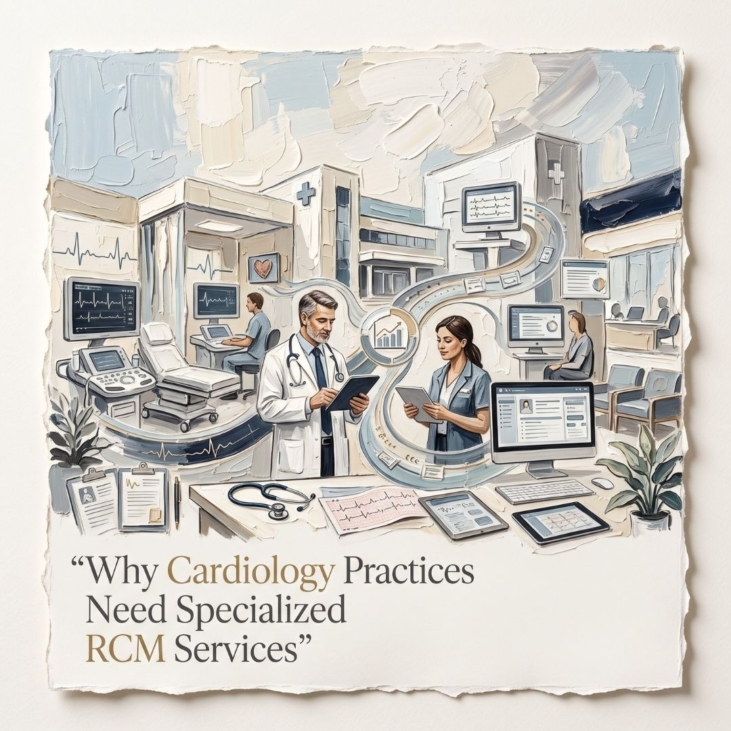
Because cardiac treatment entails complicated procedures, sophisticated diagnostics, stringent paperwork requirements, and ever evolving insurance standards, cardiology clinics need professional Revenue Cycle Management (RCM) services. Accurate coding and billing skills are necessary for services like echocardiograms, cardiac catheterization, stress testing, electrophysiology procedures, and cardiovascular imaging. Cardiology practices may experience revenue loss, delayed payments, and claim denials in the absence of effective RCM management. In addition to improving payment accuracy and streamlining financial processes, specialized cardiac RCM solutions free up physicians to concentrate more on patient care.
Complex Cardiology Billing Requires Specialty Expertise
Because cardiology billing requires numerous procedures, specific codes, and extensive documentation requirements, it is more complex than standard medical billing. To guaranty correct reimbursement, many cardiac services need precise CPT, ICD-10, and modifier usage. Understanding cardiology-specific billing regulations, a trained RCM team assists in avoiding coding mistakes that may result in underpayments or rejected claims.
Accurate Coding Improves Revenue Performance
For the cardiology revenue cycle to be successful, accurate medical coding is essential. Inaccurate coding is a frequent problem since cardiology treatments frequently include intricate combinations of services. Clinical documentation is examined by specialized RCM providers, who also apply the proper codes and make sure claims appropriately reflect the services rendered. This helps cardiology offices get the reimbursement they are due and increases claim acceptance rates.
Reducing Cardiology Claim Denials
A significant financial obstacle for cardiology practices is claim denials. Inaccurate coding, missing documentation, permission problems, and payer-specific restrictions are common causes. Proactive denial management techniques are used by specialized RCM services to find common issues, fix mistakes, and stop rejections in the future. Reducing denials decreases revenue leakage and enhances cash flow.
Managing Prior Authorization Challenges
Prior authorization is required for a number of cardiac operations, particularly advanced diagnostic testing and specialist therapies. Procedures may be delayed and claims may be rejected as a result of delays or missing approvals. By monitoring payer requirements, presenting required paperwork, and guaranteeing timely approvals, specialized RCM teams assist in managing authorization workflows.
Improving Insurance Verification Processes
Preventing billing problems requires accurate insurance verification. Because cardiology procedures can be expensive, it’s critical to verify patient eligibility, coverage information, and benefit restrictions prior to treatment. Accurate insurance information verification, lower claim rejection risks, and increased patient and provider transparency are all made possible by specialized RCM services.
Enhancing Documentation and Compliance
In order to prove medical necessity and guaranty successful reimbursement, proper documentation is required. Diagnoses, treatments, test results, and treatment plans must all be meticulously documented in cardiology offices. Specialized RCM teams assist in evaluating the quality of documentation and guaranty that billing procedures adhere to payer and healthcare requirements. This increases revenue cycle efficiency and lowers compliance risks.
Improving Accounts Receivable Management
The financial stability of cardiology clinics may be impacted by late payments and unpaid claims. Through claim follow-ups, payment tracking, and aging analysis, specialized RCM services offer organized accounts receivable administration. This enhances overall cash flow and expedites the recovery of outstanding payments. Efficient revenue collection is ensured by effective AR management.
Using Technology for Better Revenue Cycle Management
Through automation, analytics, and real-time reporting, advanced RCM technology helps cardiology offices increase productivity. Payment monitoring, eligibility verification, denial analysis, and claim tracking are all supported by automated systems. RCM solutions powered by technology improve financial performance insight and assist practices in making wise choices.
Allowing Providers to Focus on Patient Care
Healthcare providers and administrative teams may have to spend a lot of time managing billing procedures internally. Complex financial procedures, such as coding, claims, denials, and payment follow-ups, are managed by specialized RCM services. Cardiology professionals can concentrate more on providing high-quality cardiac care and enhancing patient outcomes by decreasing their administrative burden.
Conclusion
Because they handle the particular difficulties of cardiac billing, coding, documentation, and payment, specialized RCM services are crucial for cardiology practices. Specialized RCM providers assist lower denials, enhance cash flow, and increase revenue with their in-depth understanding, cutting-edge technology, and effective revenue cycle tactics. Cardiology practices might improve their financial performance while concentrating on their main objective of offering top-notch patient care by collaborating with seasoned RCM specialists.
Frequently Asked Questions
1. Why do cardiology practices need specialized RCM services?
Cardiology practices need specialized RCM services because cardiac procedures involve complex coding, documentation requirements, and insurance processes that require expert billing knowledge.
2. How can specialized RCM reduce cardiology claim denials?
Specialized RCM reduces denials through accurate coding, documentation review, authorization management, and proactive denial prevention strategies.
3. What services are included in cardiology RCM?
Cardiology RCM includes insurance verification, medical coding, claim submission, denial management, payment posting, accounts receivable follow-up, and reporting.
4. How does RCM improve cardiology practice revenue?
RCM improves revenue by reducing billing errors, speeding up reimbursements, recovering unpaid claims, and improving overall billing efficiency.
5. Can cardiology RCM services improve compliance?
Yes, specialized RCM services help maintain compliance by following updated coding guidelines, payer requirements, and healthcare billing regulations.