
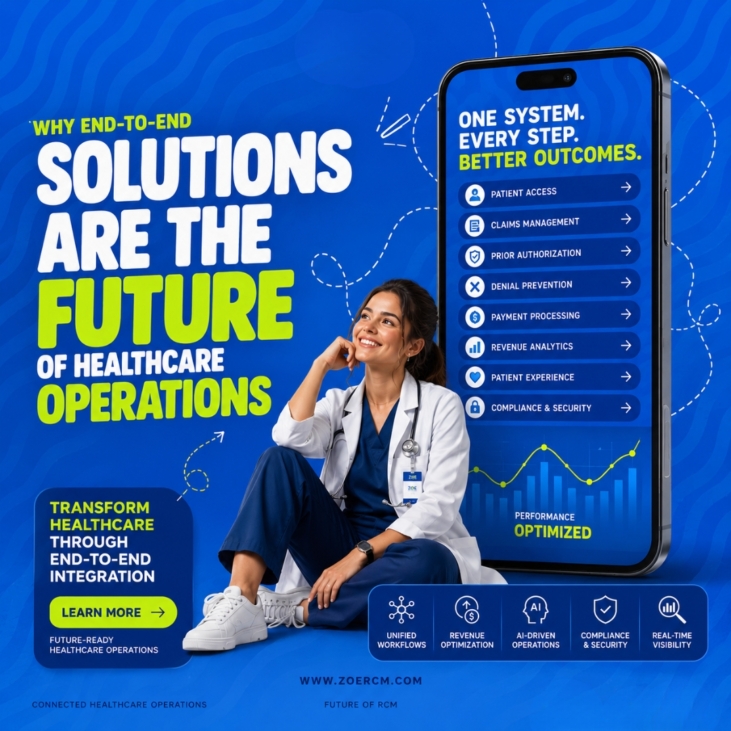
Patient demands are increasing, administrative workloads are growing, regulations are changing and digital technologies are being adopted at a rapid pace – all of which is making healthcare operations more and more complex. Communication breakdowns, delays, billing errors, and operational inefficiencies are often the result of isolated legacy systems. That’s why end-to-end healthcare solutions are the future of healthcare operations.
End-to-end solutions combine a range of healthcare functions into one integrated system, such as patient registration, appointment scheduling, billing, medical records, communication, insurance processing, analytics and reporting. Such integrated platforms help healthcare providers improve efficiency, reduce manual work, enhance patient experience and make faster decisions. In this blog, we will talk about the reasons why end-to-end solutions are transforming healthcare operations and the future of the healthcare industry.
Improved Operational Efficiency
One of the biggest advantages of end-to-end healthcare solutions is better operational efficiency. Every day, healthcare organizations manage massive amounts of patient data, appointments, billing processes, and administrative tasks. Disconnected systems across different departments slow down and complicate workflows.
Integrated end-to-end systems link all operations in one platform, reducing duplication of work and increasing coordination between departments. This enables healthcare providers to perform the tasks faster, cut down delays and increase overall productivity.
Automation is another aspect of these systems, reducing manual paperwork and routine administrative tasks, allowing staff to spend more time with patients.
Better Patient Experience
Today’s patients want faster services, easy communication, digital access and transparent healthcare processes. End-to-end healthcare solutions ease the patient journey by reducing the difficulty of appointments, access to digital records, billing, and communication.
Patients can schedule appointments online, receive automated reminders, get reports in digital formats, and communicate with healthcare providers more easily. This offers a better and more convenient healthcare experience.
Integrated systems can also cut down on waiting times and improve care coordination, leading to increased patient satisfaction and trust.
Seamless Data Management and Communication
Accurate patient information is critical for healthcare providers to diagnose, treat and bill patients. End-to-end systems mean that patient data is centralized and available in real time in departments.
Doctors, nurses, billing teams, laboratories and administrative staff all have access to the same current information, immediately. This improves communication, reduces data errors and enables faster decision making.
Additionally, centralized systems reduce the risk of lost records, duplicate entries, and miscommunication between departments.
Enhanced Revenue Cycle Management
Revenue Cycle Management (RCM) is one of the most critical areas in healthcare operations. End-to-end healthcare solutions combine billing and coding, insurance verification, claims processing and payment tracking into one workflow.
That means fewer billing errors, faster reimbursements, fewer claim denials and improved cash flow. Automated RCM systems also enable healthcare providers to better monitor financial performance.
By streamlining financial operations, healthcare organizations can improve profitability and maintain better financial stability.
Support for Digital Healthcare Transformation
The healthcare industry is rapidly moving towards digital transformation and end to end solutions play a major role in this transition. Telemedicine, cloud-based systems, AI-driven automation, and remote patient monitoring technologies are more efficient when combined into one connected platform.
End-to-end systems improve access, communications and operational management for digital healthcare services. Connected technology enables healthcare organizations to respond more quickly to changing patient expectations and industry needs.
Better Decision-Making Through Analytics
Today’s healthcare systems generate massive amounts of operational and clinical data. End-to-end healthcare solutions offer analytics and reporting tools to enable organizations to track performance, patient trends, financial data and operational efficiency.
Healthcare managers can leverage this data to recognize bottlenecks, enhance staffing, optimize resources and make smart business decisions. Real-time dashboards and predictive analytics help healthcare providers respond more quickly to operational issues.
Data-driven decision making improves patient outcomes and organizational performance.
Reduced Costs and Resource Optimization
Disconnected systems often add to operational costs through duplication of effort, inefficiencies and delays in communication. End-to-end healthcare solutions automate workflows, improve resource utilization and reduce administrative burdens, lowering costs.
Healthcare providers can more effectively optimize staffing, inventory management, scheduling, and billing processes. This increases productivity and reduces unnecessary operational costs.
Optimizing costs enables healthcare organizations to dedicate more resources to the improvement of patient care and medical technologies.
Improved Compliance and Data Security
Healthcare organizations have strict rules about patient privacy, billing, and data security. Standardized workflows and thorough record keeping in end-to-end healthcare systems improve compliance.
The integrated systems of today also include advanced cybersecurity features such as encryption, access control, and secure cloud storage. This helps safeguard sensitive patient information and reduces the risk of data breaches.
To maintain patient trust and avoid legal trouble, robust compliance and data security are essential.
Conclusion
End-to-end solutions are the future of healthcare operations, streamlining complex processes, improving efficiency and patient care, and enabling digital transformation. By integrating healthcare functions into one connected platform, healthcare providers can reduce errors, improve communication, optimize resources and make better decisions.
Looking ahead, organizations that take a comprehensive approach to healthcare will be better positioned to meet the rising needs of patients, operational challenges and to efficiently deliver quality healthcare in an industry that is constantly evolving.
FAQs
1. What are end-to-end healthcare solutions?
End-to-end healthcare solutions are integrated systems that manage multiple healthcare operations such as appointments, billing, patient records, communication, and reporting in one platform.
2. How do end-to-end solutions improve healthcare operations?
They improve efficiency, reduce manual work, streamline communication, and support faster decision-making.
3. Why are integrated healthcare systems important?
Integrated systems improve data sharing, reduce errors, enhance patient care, and simplify workflow management.
4. How do end-to-end solutions help Revenue Cycle Management?
They automate billing, claims processing, insurance verification, and payment tracking to improve cash flow and reduce denials.
5. Are end-to-end healthcare systems secure?
Yes, modern systems use advanced security features such as encryption, secure cloud storage, and access controls to protect patient data.