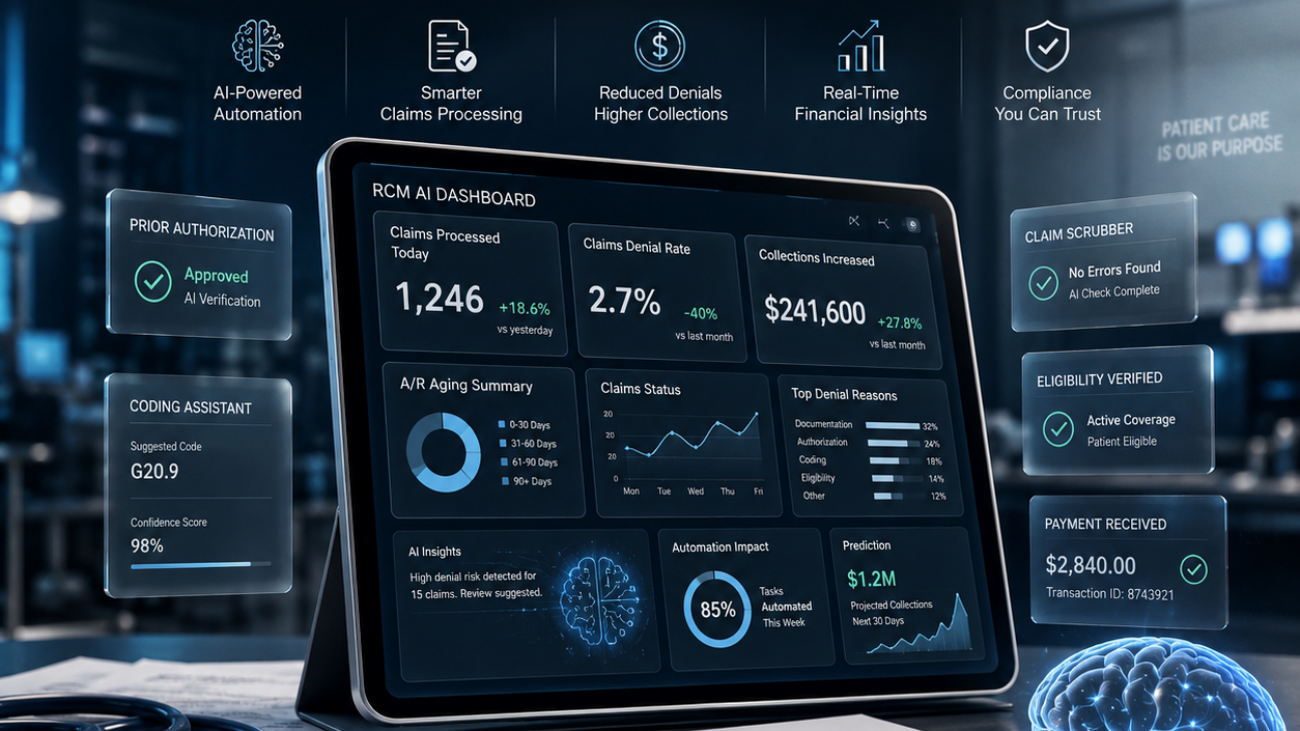

Artificial intelligence is changing the way the radiology revenue cycle is managed. The technology is making the billing process faster, more accurate and efficient. Radiology practices handle complex diagnostic services such as MRI scans, CT scans, X-rays, ultrasounds, and other imaging procedures that need accurate coding, documentation, and insurance processing. Regular billing practices can be plagued with coding errors, claim denials and slow reimbursements. AI-powered RCM solutions assist radiology providers with automating workflows, increasing claim accuracy, finding billing problems, and improving revenue performance.
AI-Powered Medical Coding Improves Accuracy
Radiology billing demands precise coding because each imaging procedure has distinct CPT, ICD-10 and payer requirements. Mistakes in manual coding can lead to claim denials, underpayments and regulatory problems. AI-based coding tools analyze clinical documentation and recommend appropriate codes for the services rendered. This increases coding accuracy, minimizes human error and helps ensure radiology practices are reimbursed properly.
Automated Claim Processing Reduces Delays
AI allows radiology practices to make claim submission easier. It automatically reviews claims before submitting them to insurance companies. Artificial intelligence systems can flag missing data, wrong codes and potential errors that could lead to rejection. Healthcare providers can improve the quality of their submitted claims, speeding up the processing and avoiding unnecessary delays in payment.
Improving Denial Management with AI
The radiology revenue cycle poses a great challenge with the denial of claims. Artificial intelligence (AI) technology can look thru lots of denied claims and find out what the usual reasons for denial are. It can recognize patterns in coding errors, documentation omissions, authorization and payer issues. With these insights, billing teams can proactively prevent problems from occurring and avoid recurring denials.
Better Prior Authorization Management
Insurance companies often require prior authorization for radiology procedures, especially advanced imaging such as MRI and CT scans. Delays and lack of approval can impact both patient care and revenue collection. AI-powered systems help to monitor authorization requirements, approval status, and possible problems before procedures are performed. This improves the workflow efficiency and reduces claim denials due to authorization issues.
Enhanced Documentation Review
Proper documentation is critical for reimbursement in radiology as insurance carriers want documentation of medical necessity. AI tools can scan medical records and determine what’s missing to make the claim successfully submitted. AI offers complete documentation, which significantly reduces the risk of non-compliance and increases the chances of claim approval.
Predictive Analytics for Revenue Optimization
AI for analytics provides actionable intelligence on revenue cycle performance for radiology practices. These systems are capable of analyzing payment trends, denial patterns, payer behavior and claim turnaround times. Predictive analytics can assist healthcare providers in identifying potential revenue risks and making smart decisions to improve financial performance.
Automating Administrative Workflows
Many revenue cycle processes such as eligibility verification, claim status tracking, payment posting and follow-up require significant manual effort. Repetitive tasks are more efficiently handled by AI automation, reducing administrative workload. This allows billing teams to focus on more complex issues requiring human expertise and thereby increases overall productivity.
Improving Patient Financial Experience
AI also enhances the patient billing experience with faster insurance verification, accurate cost estimates and improved communication. Patients have increased transparency about their financial obligations, pre- and post- service, due to radiology services. Increased transparency will improve patient satisfaction and allow for more effective payment collection.
Reducing Operational Costs
AI-powered RCM solutions help radiology practices reduce operational costs by eliminating manual work, avoiding billing errors and increasing workflow efficiency. Automation cuts down on repetitive administrative tasks and increases accuracy. This enables healthcare organizations to better control revenue cycles without adding operational complexity.
Ensuring Compliance and Data Security
Radiology practices are bound by strict healthcare regulations and must safeguard confidential patient information. AI-driven RCM platforms help maintain compliance by monitoring the billing processes, identifying irregularities and ensuring secure data management. Such systems mitigate compliance risks and ensure accurate and efficient revenue operations.
Conclusion
AI is transforming radiology revenue cycle management by improving coding accuracy, automating billing processes, reducing claim denials, and accelerating reimbursements. As radiology services become more complex, AI-powered solutions provide healthcare providers with the tools needed to manage revenue cycles efficiently. By adopting AI technology, radiology practices can reduce administrative challenges, improve financial performance, and focus more on delivering quality patient care.
Frequently Asked Questions
1. How is AI used in radiology revenue cycle management?
AI is used for automated coding, claim review, denial analysis, documentation checks, insurance verification, and revenue cycle analytics.
2. Can AI reduce claim denials in radiology practices?
Yes, AI helps identify coding errors, missing documentation, authorization issues, and other problems before claims are submitted.
3. How does AI improve radiology billing accuracy?
AI analyzes medical documentation and billing data to recommend accurate codes, detect errors, and improve claim quality.
4. What are the benefits of AI-based RCM solutions for radiology practices?
Benefits include faster reimbursements, fewer denials, reduced administrative workload, improved compliance, and better revenue performance.
5. Will AI replace radiology billing professionals?
AI will not completely replace billing professionals. Instead, it supports them by automating repetitive tasks and allowing teams to focus on complex revenue cycle activities.