Future Trends in Healthcare Technology and RCM

Future Trends in Healthcare Technology and RCM

The healthcare industry is going through a rapid digital transformation and technology is playing a big part in shaping healthcare operations and financial management. Revenue Cycle Management (RCM) is also evolving with advanced digital tools and automation technologies for managing financial processes of healthcare organizations. From artificial intelligence and predictive analytics to cloud-based systems and telemedicine, healthcare providers are increasingly tapping into smarter solutions to enhance patient care, boost operational efficiency and improve financial performance.

As the demands from patients, regulatory requirements and financial challenges continue to increase for healthcare organizations, modern healthcare technology and RCM solutions are becoming more important than ever. This blog will talk about the future trends that will change healthcare technology and Revenue Cycle Management. 

Artificial Intelligence and Automation in Healthcare

Artificial Intelligence (AI) is becoming one of the most important technologies in the healthcare of today. Systems powered by AI help healthcare providers automate repetitive tasks, analyze patient data, improve the accuracy of diagnosis, and optimize healthcare operations.

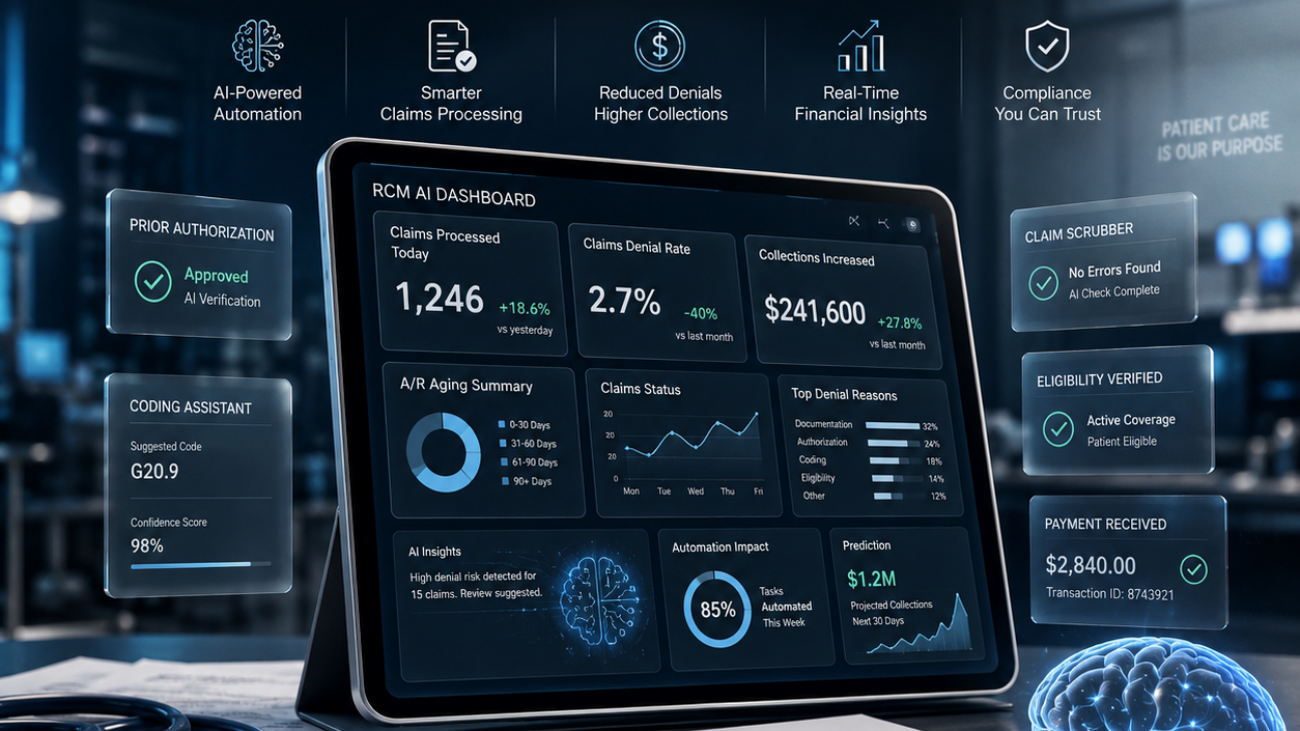
AI is assisting to automate medical billing, coding, claim verification and denial management processes in Revenue Cycle Management. Automation can help identify billing errors, reduce claim denials and improve reimbursement accuracy. This not only increases operational efficiency but also helps healthcare organizations to increase revenue and reduce administrative workloads.

AI chatbots and virtual assistants are also improving patient engagement by managing appointment scheduling, responding to common patient inquiries, and sending payment reminders. 

Cloud-Based Healthcare and RCM Solutions

Cloud computing is revolutionizing the way healthcare organizations manage patient records and financial operations. With cloud-based healthcare systems, providers can store and access data safely from anywhere, which enhances the flexibility and collaboration between departments.

Cloud-based RCM solutions simplify billing, payment tracking, insurance verification and financial reporting . Health care providers no longer need costly physical servers or complex IT infrastructure, making cloud technology cheaper and more scalable.

Access from anywhere, sharing of data and real-time management of operations through secure cloud systems will increasingly shape the future of healthcare management. 

Predictive Analytics for Better Decision-Making

Predictive analytics is enabling faster and smarter decision making for healthcare organizations. Predictive tools use massive patient and operational data to identify healthcare trends, predict patient risks and improve resource planning.

Predictive analytics in RCM helps healthcare providers forecast revenue, identify payment delays, reduce claim denials, and improve financial performance. Healthcare organizations can also leverage predictive models to optimize staffing, manage patient flow and improve treatment outcomes.

As health care data continues to grow, predictive analytics will become even more important in improving both clinical and financial decision-making. 

Telemedicine and Remote Patient Management

Telemedicine is one of the fastest growing trends in healthcare technology. Digital healthcare services, such as remote monitoring and virtual consultations, are making healthcare more accessible and convenient for patients.

Healthcare organizations are combining telemedicine with RCM systems to make billing, digital payments, insurance claims and patient communication more efficient. Remote healthcare solutions enable healthcare providers to better manage appointments, prescriptions and follow-ups.

The future of healthcare delivery will likely incorporate telemedicine and remote health care technologies as a standard of care, particularly in rural and underserved areas. 

Electronic Health Records and Interoperability

Electronic Health Records (EHR) are still evolving with intelligent features and better system integration. Modern healthcare systems emphasize interoperability, which allows patient information to be shared seamlessly between different healthcare platforms and departments.

Better interoperability allows doctors, hospitals, laboratories and insurance providers to communicate more effectively. It removes delays, improves accuracy of diagnosis and helps better coordination of patient care.

Future healthcare systems will focus on connected healthcare ecosystems with real-time access to patient information from multiple platforms. 

Cybersecurity and Data Protection

Cybersecurity has become a top priority for healthcare organizations adopting digital technologies. Healthcare systems are susceptible to cyberattacks because they contain extremely sensitive patient and financial information.

In the future, healthcare technology and RCM systems will be more secure with advanced encryption, multi-factor authentication, and AI-based threat detection. Healthcare organizations will continue to make protecting patient data and meeting regulatory requirements a top priority.

Healthcare providers will be expected to make significant investments in cybersecurity infrastructure to protect the safe and secure delivery of digital healthcare. 

Patient-Centered Digital Experiences

Modern patients want an easy personalized healthcare experience. Future healthcare systems are placing greater emphasis on patient engagement via digital platforms, mobile apps and self-service portals.

Integrated healthcare systems allow patients to book appointments, access their medical records, get digital prescriptions and make payments online. RCM platforms are also improving transparency by helping patients see billing information and insurance coverage more clearly.

The future of healthcare technology will continue to focus on making care more convenient, accessible and communicative for patients. 

Conclusion 

The future of healthcare technology and Revenue Cycle Management is powered by innovation, automation and digital transformation. AI, cloud computing, predictive analytics, telemedicine, and advanced cybersecurity are transforming healthcare operations and financial management.

Healthcare organizations that take advantage of these future trends will be better positioned to improve patient care, streamline operations, lower costs and improve financial performance. With the development of technology, the modern healthcare systems will be smarter, faster and more patient-focused, resulting in the more efficient and connected healthcare industry. 

FAQs

1. What is Revenue Cycle Management (RCM)?

RCM is the process of managing the financial operations of healthcare organizations, including billing, claims processing, payment collection, and revenue tracking.

2. How is AI changing healthcare and RCM?

AI helps automate administrative tasks, improve billing accuracy, reduce claim denials, and support faster healthcare decision-making.

3. Why are cloud-based healthcare systems important?

Cloud systems provide secure remote access to healthcare data, improve collaboration, reduce infrastructure costs, and support scalable healthcare operations.

4. What role does predictive analytics play in healthcare?

Predictive analytics helps healthcare providers forecast trends, improve patient care, optimize resources, and enhance financial planning.

5. How does telemedicine impact healthcare operations?

Telemedicine improves healthcare accessibility, supports remote patient care, and simplifies digital healthcare management and billing processes.

Modern healthcare management system dashboard used by healthcare professionals in a digitally advanced hospital environment.

The Evolution of Healthcare Management Systems

For years, healthcare management systems have seen a huge transformation. The healthcare industry has continuously evolved from managing paper-based patient data to implementing complex digital platforms to improve efficiency, accuracy, and patient care. With increasing patient demands, complex administrative tasks and rising operational costs, healthcare organizations are relying more on modern healthcare management systems to ensure smooth and effective healthcare delivery.

Healthcare management systems today are pivotal in managing patient data, hospital operations, billing processes, appointment scheduling, and interdepartmental communication. The evolution of these systems has led not only to more effective health care but has also changed the entire patient experience. In this blog, we will have a look at the evolution of healthcare management systems and how they continue to impact healthcare operations today. 

The Early Days of Healthcare Management

During the early years of healthcare administration, hospitals and clinics depended on manual paperwork for patient records, billing, and medical documentation. All data was stored physically and working with large amounts of data efficiently was impossible.

This traditional system often led to communication delays, misplaced records, billing errors, and longer patient wait times. Healthcare providers were spending too much time on administrative tasks rather than patient care. However, the expansion of the healthcare industry revealed the shortcomings of manual systems and increased the demand for more structured and effective management solutions. 

The Introduction of Digital Record Systems

The advent of computers heralded the beginning of the digital revolution in health care management. Hospitals began to use simple software systems to put patient records, billing information, and appointment scheduling into digital form.

Electronic Health Records (EHR) and Electronic Medical Records (EMR) are among the most significant developments in the healthcare technology arena. They allowed healthcare providers to access patient information quickly and securely, enhancing communication among doctors, nurses, and administrative staff.

The digital record systems reduced the paper work, made the documentation more accurate and reduced the chances of losing important patient information. “This was a huge improvement for the efficiency of operations and management of patient care.” 

The Rise of Integrated Healthcare Management Systems

Healthcare organizations started implementing integrated healthcare management systems, which consolidated several functions into a single platform, as technology developed. Patient registration, billing, medication administration, laboratory reporting, inventory management, and staff scheduling were all made easier by these technologies.

Workflow coordination across various departments in hospitals and clinics was enhanced via integrated systems. Healthcare practitioners were able to improve overall treatment quality and operational performance by making quicker and more informed decisions because to real-time data availability.

In order to help healthcare providers better monitor performance, patient trends, and operational efficiency, healthcare management systems have also begun to incorporate analytics and reporting tools. 

Cloud-Based Healthcare Management Solutions

Another significant advancement in healthcare management systems was brought forth by cloud technology. Cloud-based solutions improved flexibility and collaboration by enabling healthcare businesses to safely store and retrieve data from any location.

Hospitals and clinics no longer need costly physical servers or complicated IT infrastructure thanks to cloud-based healthcare technologies. Remote, secure access to patient records would enhance communication and care continuity for medical personnel.

Additionally, cloud technology improved system scalability, cybersecurity, and data backup, making healthcare administration more dependable and effective for businesses of all sizes. 

The Impact of Artificial Intelligence and Automation

Healthcare management systems are currently undergoing significant changes due to automation and artificial intelligence (AI). AI-powered solutions enhance clinical decision-making, evaluate patient data, automate administrative activities, and forecast healthcare trends.

Automation has reduced human labor and operational delays by streamlining patient follow-ups, billing, insurance claim processing, and appointment scheduling. Healthcare firms may find inefficiencies, allocate resources more effectively, and improve patient outcomes with the aid of AI-driven data.

Healthcare professionals are using chatbots, virtual assistants, and predictive healthcare systems more frequently to provide quicker and more individualized care. 

Telemedicine and Remote Healthcare Management

Healthcare management systems now have even more capabilities thanks to the expansion of telemedicine. Digital prescriptions, online appointment scheduling, remote patient monitoring, and virtual consultations are all supported by contemporary technologies.

Telemedicine technologies, which enable patients to safely get medical consultations from home, proved particularly crucial during global health emergencies. These days, integrated healthcare management systems are essential for establishing safe online connections between physicians and patients.

Access to healthcare has been enhanced by remote healthcare management, particularly for patients who reside in underserved or rural locations. 

Benefits of Modern Healthcare Management Systems

Both patients and healthcare organizations can benefit greatly from modern healthcare management systems. They eliminate medical errors, increase operational efficiency, cut down on paperwork, and improve patient experiences.

In addition to improving data security and regulatory compliance, healthcare providers may now more efficiently handle appointments, billing, patient information, and communication. Additionally, faster treatments, simpler access to medical information, and better healthcare coordination are advantageous to patients.

Healthcare organizations are able to provide more intelligent, quicker, and patient-centered treatment because to these systems’ ongoing evolution with cutting-edge technologies. 

Conclusion 

The healthcare sector has radically changed as a result of the development of healthcare management systems. Healthcare management systems have greatly increased operational effectiveness, patient care, and healthcare accessibility from manual paperwork to intelligent digital platforms driven by AI and cloud technologies.

Healthcare firms will depend more and more on intelligent management systems to manage intricate operations and satisfy rising patient expectations as technology develops. Innovation, automation, and data-driven decision-making that benefits patients and healthcare providers are key components of the future of healthcare administration. 

FAQs

1. What is a healthcare management system?

A healthcare management system is a digital platform used to manage patient records, billing, appointments, hospital operations, and healthcare workflows.

2. How have healthcare management systems evolved?

They have evolved from paper-based record systems to advanced digital platforms using cloud computing, AI, automation, and telemedicine technologies.

3. What are the benefits of healthcare management systems?

They improve efficiency, reduce errors, enhance patient care, streamline operations, and support better healthcare decision-making.

4. How does AI improve healthcare management systems?

AI helps automate tasks, analyze healthcare data, improve scheduling, support clinical decisions, and enhance operational efficiency.

5. Why are cloud-based healthcare systems important?

Cloud-based systems provide secure remote access to healthcare data, improve collaboration, reduce infrastructure costs, and enhance data security.

Healthcare professionals using digital systems and optimized workflows to improve hospital operations and patient care.

The Role of Process Optimization in Healthcare Success

Today, healthcare organizations are under increasing pressure to deliver quality patient care while controlling rising operational costs and administrative challenges. In such a demanding environment, optimizing the processes has become one of the most important strategies to ensure long-term success in healthcare. In healthcare, process optimization means doing things better by streamlining workflows, eliminating wasted steps, reducing wait times, and using resources more efficiently to improve overall efficiency.

Optimized healthcare processes help hospitals and clinics to provide faster services, improve patient satisfaction, reduce errors and increase staff productivity. Streamlined processes benefit all aspects of healthcare operations, from appointment scheduling and patient registration to billing and treatment coordination. In this blog, we will discuss the importance of process optimization in the success of healthcare and why it is a must in today’s healthcare industry. 

Improving Operational Efficiency

One of the greatest benefits of process optimization is that it makes operations more efficient. Healthcare facilities are busy places, with thousands of daily activities like admitting patients, diagnostics, treatment planning, discharge management, and more. Lack of efficient systems can lead to delays and confusion, which can impact staff performance and patient care.

Optimized processes help healthcare providers streamline workflows and cut down on repetitive tasks. With automation tools, digital record systems and integrated communication platforms, healthcare staff can perform tasks more quickly and accurately. This reduces the patient waiting time, improves the inter-departmental co-ordination, thus leading to the efficient healthcare delivery. 

Enhancing Patient Care and Experience

Patient experience is a key area of focus in health care. Extended wait times, administrative errors and communication gaps can negatively impact patient satisfaction. Process optimization improves the patient journey by delivering healthcare services more efficiently and consistently.

When hospitals improve appointment scheduling, patient registration and access to medical records, patients are seen more quickly and better served. Optimized workflows also means healthcare professionals have more time to spend on patient care and less time on administrative tasks. This makes patients feel more valued, better informed and more satisfied with their healthcare experience. 

Reducing Operational Costs

Healthcare organizations are constantly seeking ways to reduce costs without compromising the quality of care. It allows to optimize the processes and thus reduce unnecessary costs through better use of resources and less waste.

Low operational costs – Effective inventory management, improved staff scheduling and automated billing systems can help to significantly reduce operational costs. Hospitals can often streamline their workflows to reduce delays, paperwork and administrative burdens. This results in better financial management and enables healthcare providers to invest more towards enhancing patient services and medical technologies. 

Reducing Medical Errors and Improving Accuracy

Precision is key in health care.” Mistakes in patient records, billing, medication management, or communication can have dire consequences. Process optimization improves accuracy by establishing standards for procedures and limiting manual work.

Digital healthcare systems like Electronic Health Records (EHR) help to keep patient information up to date and in real time. Automation also helps to reduce data entry errors and allows for better coordination between physicians, nurses and administrative staff. Healthcare organizations can improve process accuracy to deliver safer, more reliable patient care. 

Supporting Better Decision-Making

Data is the lifeblood of modern healthcare organisations and they rely on it heavily to make informed decisions. Process optimization helps healthcare providers to collect, analyze and use operational data more effectively.

Optimized systems allow healthcare managers to monitor patient flow, staff performance, treatment outcomes and operational efficiency in real-time. This data can be used to spot bottlenecks and improve resource planning and support better strategic decisions. Reporting tools and predictive analytics also enable healthcare facilities to prepare for future challenges and improve overall performance. 

Increasing Staff Productivity and Satisfaction

Medical professionals are often working under stress and heavy workloads. Staff members can become frustrated and burnt out on inefficient systems and repetitive admin work.

Routine task automation and simplified communication processes lead to the reduction of unnecessary workloads through process optimization. When healthcare staff are working more efficiently they are less stressed and more satisfied with their jobs. Better workflow also promotes better teamwork and collaboration, resulting in a more productive healthcare environment. 

Adapting to Digital Transformation in Healthcare

The healthcare industry is undergoing a rapid digital transformation, and process optimization is a crucial part of this transition. Healthcare organizations are transforming their operations with technologies such as telemedicine, AI-powered systems, cloud-based healthcare platforms, and automated billing solutions.

Healthcare providers can improve efficiency, enhance patient engagement and remain competitive in a fast-changing industry by optimizing processes as well as digital transformation. Those healthcare facilities that implement new technologies and process improvements will be better positioned to meet patient expectations and industry demands. 

Conclusion 

Process optimization is a requirement for success in the healthcare industry. Optimizing healthcare processes leads to greater operational efficiency, cost reductions, improved patient care and supports digital transformation, making the healthcare system stronger and more sustainable.

Healthcare organizations that focus on continuous process improvement are better able to deliver better patient experiences, improve staff productivity and maintain financial stability in an increasingly competitive environment. As healthcare continues to evolve, process optimization will be key to providing high quality, efficient, patient-centered care. 

FAQs

1. What is process optimization in healthcare?

Process optimization in healthcare involves improving workflows and operational systems to increase efficiency, reduce costs, and enhance patient care.

2. How does process optimization improve patient experience?

It reduces waiting times, improves communication, streamlines services, and ensures patients receive faster and more efficient care.

3. Why is process optimization important in hospitals?

It helps hospitals improve efficiency, reduce operational expenses, minimize errors, and deliver better healthcare services.

4. Can technology help with healthcare process optimization?

Yes, technologies like Electronic Health Records (EHR), automation tools, AI systems, and telemedicine platforms significantly improve healthcare workflows.

5. How does process optimization reduce healthcare costs?

It minimizes waste, improves resource management, reduces paperwork, and automates repetitive tasks, leading to lower operational expenses.