
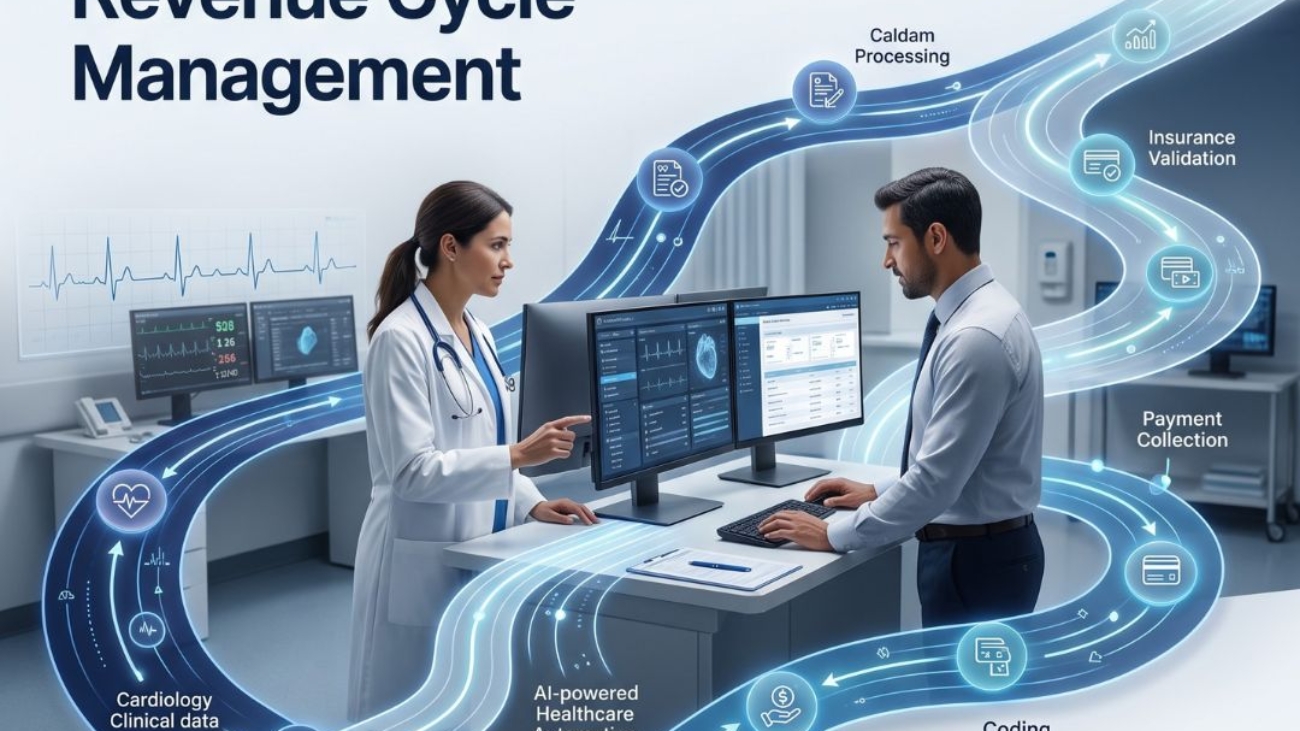
Automated cardiology revenue cycle management system

How Automation Is Transforming Cardiology Revenue Cycle Management

Automation is revolutionizing the revenue cycle management for cardiologists by making the billing operations faster, accurate and efficient. Cardiology practices perform complex procedures like cardiac imaging, catheterization, electrophysiology services, and chronic care management. These procedures require accurate coding and documentation. Manual billing processes are prone to errors, delays in claims and administrative challenges. The automation allows cardiology providers to improve workflows, increase claim accuracy, decrease denials and have a more robust revenue cycle, while giving healthcare teams more time for patient care. 

Automated Medical Coding Improves Billing Accuracy 

Cardiology billing is no different as it requires a thorough knowledge of CPT codes, ICD-10 codes, modifiers, and payer-specific guidelines. Manual coding errors can lead to claim rejection, payment delays or compliance issues. Automated coding solutions analyze clinical documentation and assist in assigning appropriate codes for services provided. This results in better billing accuracy, fewer human errors and ensures cardiology practices are adequately reimbursed for their services.

Automated Claim Processing Speeds Up Reimbursements 

It also assists cardiology practices in improving the claim submission process by reviewing the claims before sending them to insurance providers. The automation systems can highlight missing information, wrong coding details, and even possible errors that may cause rejection. Clean claims submission results in higher approval rates and less reimbursement delays. Faster claims processing means better cash flow and improved financial stability.  

Reducing Cardiology Claim Denials Through Automation 

Denials are one of the biggest challenges in managing the cardiology revenue cycle. Common reasons for denial that can be flagged by automation include coding errors, insufficient documentation, authorization problems and payer-specific rules. Automated denial tracking systems analyze patterns in rejections and provide insights so that future mistakes can be avoided. This enables billing teams to fix issues faster and recoup lost revenue more effectively.

Streamlining Insurance Verification and Eligibility Checks 

Insurance verification is an important step to avoid billing issues. Procedures in cardiology typically involve costly diagnostic tests and treatments, necessitating accurate coverage information. Automated eligibility verification tools quickly verify patient insurance, benefits and coverage requirements. This reduces manual effort, prevents unexpected claims issues and improves the overall patient billing experience.” 

Improving Prior Authorization Management 

Several cardiology procedures require prior authorization before treatment. Manual approval management can cause delays and missed requirements. Automation helps to track authorization requests, to monitor approval status and to ensure required documents are submitted on time. A simpler authorization process reduces procedural delays and claim denials due to missing approvals.

Enhancing Documentation Review 

Cardiology Reimbursement Needs Complete and Accurate Documentation Automation tools can scan through medical records to point out missing information that is needed to support claims. These systems help to ensure proper documentation of diagnosis information, procedure notes and medical necessity requirements. Good documentation leads to better claim acceptance and lesser compliance risks. 

Using Data Analytics for Better Revenue Decisions 

Automation helps advanced analytics deliver critical information to cardiology practices about their revenue cycle. Automated systems can track denial trends, reimbursement patterns, payment timelines and accounts receivable performance. These insights inform practice managers about the challenges they face, improve workflows, and make data-driven decisions. Better visibility into revenue performance supports long-term financial growth.

Reducing Administrative Workload 

Manual billing activities such as claim tracking, payment posting, follow-ups, and reporting require significant time and resources. Automation handles repetitive tasks more efficiently, allowing billing teams to focus on complex issues that need human expertise. Reduced administrative workload improves productivity and helps cardiology practices operate more efficiently. 

Improving Compliance and Security 

Healthcare billing must strictly comply with regulations and data protection standards. Automated RCM systems also help in maintaining accurate records, following billing activities and help in safe data management. Automation reduces manual errors and increases process consistency, enabling cardiology practices to meet compliance and reduce financial risk.

The Future of Automation in Cardiology RCM 

The future of cardiology revenue cycle management will continue to trend toward intelligent automation powered by artificial intelligence, machine learning, and advanced analytics. These technologies will help practices predict claim issues, improve decision-making and create more personalized revenue strategies. As cardiology services grow more complex, automation will increasingly help improve efficiency and financial performance. 

Conclusion 

By increasing accuracy, lowering administrative difficulties, and speeding up reimbursement procedures, automation is transforming cardiology revenue cycle management. Technology makes it easier for cardiology practices to handle complicated billing requirements, from automated coding and claim processing to denial prevention and analytics. Cardiology providers can lower operating costs, increase revenue performance, and concentrate more on providing high-quality patient care by implementing automation solutions. 

Frequently Asked Questions

1. How does automation improve cardiology revenue cycle management?

Automation improves cardiology RCM by streamlining billing processes, reducing errors, improving claim accuracy, and speeding up reimbursements.

2. Can automation reduce cardiology claim denials?

Yes, automation helps identify coding errors, missing documentation, authorization issues, and payer-related problems before claims are submitted.

3. What cardiology billing tasks can be automated?

Tasks such as insurance verification, coding assistance, claim processing, payment tracking, denial analysis, and reporting can be automated.

4. How does automation benefit cardiology billing teams?

Automation reduces repetitive manual tasks, improves productivity, and allows billing teams to focus on complex revenue cycle challenges.

5. Will automation replace medical billing professionals?

Automation will not replace billing professionals but will support them by improving efficiency and allowing them to focus on decision-making and complex billing activities.


op Reasons Healthcare Providers Outsource Revenue Cycle Management

Top Reasons Healthcare Providers Outsource Revenue Cycle Management

Healthcare providers are increasingly outsourcing revenue cycle management (RCM) as a means to improve financial performance, reduce administrative burdens and enable efficient billing processes. In-house management of the entire revenue cycle requires expertise in medical coding, insurance processes, claim processing, compliance and payer rules. Outsourced RCM services are a great solution for healthcare organizations as they come with specialized knowledge, the latest technology, and dedicated teams to help reduce claim denials, speed up reimbursements, and improve overall revenue management. 

Improved Billing Accuracy and Coding Efficiency 

Medical billing involves using the correct codes to help healthcare providers get paid for the services they offer. Errors in CPT codes, ICD-10 codes, modifiers or documentation can cause claim denials and lost revenue. Outsourcing RCM allows providers to tap into trained coding professionals who understand the billing requirements specific to a specialty and the payer guidelines. This increases the accuracy of claims, decreases billing errors and assures compliance with healthcare regulations.

Reduction in Claim Denials 

Claim denials are among the biggest financial challenges facing healthcare providers. Payment can be delayed due to incorrect patient information, coding errors, authorization issues, and documentation gaps. Outsourced RCM teams use denial management strategies to identify the causes of rejected claims, correct errors, and prevent future denials. This helps healthcare providers recover lost revenue and improve their reimbursement rates. 

Faster Insurance Verification and Authorization Management 

Insurance verification and prior authorization can take a lot of time and be complicated. Frequent errors or delays in these areas often lead to denied claims and delayed treatments. These RCM outsourcing providers take care of eligibility checks, benefit verification and authorization requirements before services are delivered. That means smoother workflows, less risk of payment and a better patient experience overall.

Lower Operational Costs 

It is costly to maintain an in-house RCM team and it requires investment in hiring, training, technology, software and compliance updates on an ongoing basis. Outsourcing eliminates many of these costs by providing access to experienced professionals and sophisticated billing systems. Healthcare providers can lower operational costs without adding administrative resources and still sustain revenue cycle processes of high quality. 

Access to Advanced Technology and Automation 

Outsourced RCM companies leverage advanced technologies such as artificial intelligence, automation tools, analytics platforms, and electronic health record integrations. These technologies improve claim processing, identify billing errors, track payments and offer valuable financial insights. Modern solutions benefit healthcare providers without the heavy investment in technology infrastructure.

Better Focus on Patient Care 

Administrative tasks like billing follow-ups, submission of claims, tracking payments, and communicating with insurance can take a lot of valuable time away from healthcare providers. When RCM activities are outsourced, doctors and clinical teams can spend more time on diagnosis, treatment and improving patient outcomes. An efficient revenue cycle enables healthcare organizations to provide better care and maintain smooth financial operations. 

Specialized Industry Expertise 

Health care billing rules and payer requirements are ever-changing. It can be challenging for specialty practices like cardiology, neurology, orthopedics, and gastroenterology to keep up with these updates in-house. Outsourced RCM teams have an in-depth knowledge of different healthcare specialties, payer policies and compliance requirements. This expertise helps providers maintain accuracy in the billing process and improve their revenue performance.

Improved Accounts Receivable Management 

Delayed payments and increasing accounts receivable can affect the financial stability of healthcare organizations. RCM teams outsourced also track unpaid claims, follow up with insurance companies and work on outstanding balances. Regular tracking and collection strategies help reduce payment delays and improve cash flow. Better accounts receivable management ensures a healthier revenue cycle. 

Data Analytics and Performance Reporting 

Offshore RCM providers provide complete reports and analytics that help healthcare organizations understand their financial performance. Metrics such as denial rates, reimbursement trends, claim turnaround time, and payer performance provide valuable insight. These reports help providers identify challenges, enhance workflows and make data-driven decisions that improve financial outcomes.

Ensuring Compliance and Security 

Healthcare organizations must adhere to stringent regulations around billing, patient data privacy and compliance requirements. Outsourced RCM providers are familiar with current healthcare regulations and have secure processes in place to protect sensitive information. This reduces compliance risks and ensures that billing operations follow industry standards. 

Conclusion 

Outsourcing revenue cycle management helps healthcare providers improve efficiency, reduce administrative burden, and strengthen financial performance. From accurate coding and denial management to advanced technology and compliance support, outsourced RCM solutions provide complete revenue cycle expertise. By partnering with experienced RCM providers, healthcare organizations can improve reimbursements, reduce operational costs, and focus more on delivering quality patient care.

Frequently Asked Questions

1. Why do healthcare providers outsource RCM services?

Healthcare providers outsource RCM services to improve billing accuracy, reduce claim denials, lower operational costs, and increase revenue efficiency.

2. What services are included in outsourced RCM?

Outsourced RCM includes patient registration, insurance verification, medical coding, claim submission, denial management, payment posting, accounts receivable follow-up, and reporting.

3. Can outsourcing RCM reduce claim denials?

Yes, outsourced RCM teams help reduce denials through accurate coding, documentation review, authorization management, and proactive denial prevention strategies.

4. Is RCM outsourcing beneficial for specialty practices?

Yes, specialty practices benefit from RCM outsourcing because experienced teams understand specialty-specific coding requirements, payer rules, and billing challenges.

5. How does RCM outsourcing improve healthcare revenue?

RCM outsourcing improves revenue by reducing billing errors, speeding up reimbursements, recovering unpaid claims, and improving overall revenue cycle efficiency.

Medical Billing Challenges in Cardiology Practices

Top Medical Billing Challenges in Cardiology Practices

Cardiology practices handle a wide range of complex diagnostic tests, interventional procedures, imaging services and long-term patient care. This complexity demands a high level of accuracy, detailed documentation, and adherence to the constantly changing payer guidelines for medical billing in cardiology. Small billing errors can lead to denied claims, delayed reimbursements and lost revenue. Common billing challenges can provide valuable insight to help cardiology practices strengthen their revenue cycle management, improve cash flow and focus on delivering high quality patient care. 

Complex Cardiology Coding Requirements

Cardiology is one of the most specialized areas of healthcare and involves a variety of diagnostic tests, interventional procedures, and surgical treatments. Electrocardiograms (ECG) Echocardiograms Cardiac Catheterization Angioplasty Pacemaker implantation Stress tests Electrophysiology studies All of these have specific coding guidelines and documentation requirements. The coding of CPT, ICD-10 or HCPCS can lead to denied claims, underpayment or compliance issues from a small mistake in the coding. Cardiology practices require experienced coders who understand the nuances of billing requirements specific to the specialty because coding standards and payer policies are often revised. Accurate coding not only helps ensure proper reimbursement, but it also reduces administrative rework and improves overall revenue cycle performance. 

Frequent Claim Denials 

One of the most common revenue cycle challenges that cardiology practices face is claim denials. Denials by insurance companies can be due to incorrect coding, missing clinical documentation, no medical necessity, missing modifiers, patient eligibility issues, or not meeting payer specific requirements. Each denied claim requires additional time and resources to correct and resubmit, increasing administrative costs and delaying payments. Cardiology practices can improve first-pass claim acceptance rates and reduce revenue leakage with proactive denial management strategies, including routine review of denial trends and quality checks before claims are filed. 

Prior Authorization Challenges 

Prior authorization from insurance providers is required before treatment can begin for many advanced cardiology procedures, diagnostic imaging services, implantable cardiac devices and specialty medications. The authorization process often requires the submission of extensive clinical records, physician notes and supporting medical evidence, which can be time consuming. Delays in approval can delay patient treatment, adversely affecting patient satisfaction and revenue generation. By creating an effective authorization process, utilizing automation tools, and tracking authorization status, cardiology practices can reduce delays, improve compliance, and ensure prompt reimbursement. 

Insurance Verification Issues

Insurance verification is a critical part of the cardiology revenue cycle as the patient’s coverage plan, limits, and policy details change often. Failure to verify insurance eligibility prior to appointments or procedures can result in denied claims, unexpected patient balances, and delayed payments. Insurance pre-authorization helps the billing team to check patient benefits, determine financial responsibility, and confirm that the services provided are covered under the patient’s insurance plan. Automation of eligibility verification systems helps to reduce manual errors, improve billing accuracy, and improve the patient experience. 

Managing High-Value Cardiology Procedures 

Cardiology practices often provide costly, highly specialized procedures with multiple billable services. Proper documentation and coding of each element of care are essential for procedures such as angiography, cardiac catheterization, coronary interventions, pacemaker insertion, and electrophysiology studies. Small billing errors can cause significant financial losses, as these procedures carry higher reimbursement values. Specialized billing processes help practices maximize reimbursement and stay compliant by making sure every service is documented, coded and submitted correctly per payer requirements. 

Changing Payer Guidelines 

Reimbursement policies, medical necessity criteria, documentation requirements, and coding guidelines for cardiology services are frequently updated by insurance companies. Frequent changes can make it difficult for internal billing teams to stay current, particularly in busy practices. Failure to follow payer updates may result in claim denials, payment reductions or compliance risks. Cardiology practices can maintain compliance and minimize preventable billing mistakes through ongoing staff training, periodic policy reviews, and access to updated billing resources. 

Delayed Reimbursements 

Delayed reimbursements are a common problem impacting the financial stability of cardiology practices. Claims can be unpaid because of incomplete documentation, the payer’s delay in processing, a coding discrepancy, or pending authorizations. Extended payment cycles increase accounts receivable balances and reduce cash flow, which makes it more difficult for practices to meet operational costs. Managing accounts receivable effectively, following up on claims in a timely manner, and tracking payments automatically will help accelerate reimbursements and maintain consistent financial performance. 

Compliance and Regulatory Requirements 

Cardiology billing is governed by a complex set of healthcare regulations, insurance policies and industry standards. Failure to follow coding guidelines, documentation requirements, HIPAA regulations and payer-specific billing rules can result in expensive audits and penalties for healthcare organizations. If there is non-compliance it can lead to loss of money, legal issues and damage to the reputation of the practice. With ongoing staff education, regular compliance audits and sophisticated billing software, cardiology practices can be in regulatory compliance, improve billing accuracy and improve operational efficiencies. 

Benefits of Specialized Cardiology Medical Billing Services 

Specialized cardiology medical billing services are built to manage the specific complexities of cardiovascular care. Skilled billing specialists understand the intricacies of complex cardiology procedures, payer-specific requirements and the constant evolution of coding standards. They help practices reduce claim denials, improve coding accuracy, manage prior authorizations, accelerate reimbursements and optimize revenue cycle performance. Specialized cardiology billing processes or outsourcing medical billing to specialists can help healthcare providers alleviate their administrative burden, improve financial performance, and spend more time providing great patient care. 

Conclusion 

Medical billing in cardiology is complex relative to most other specialties because of specialized procedures, changing coding standards, and rigid insurance requirements. Financial performance can be significantly impacted by challenges such as claim denials, prior authorizations, coding accuracy and delayed reimbursements.

Effective revenue cycle management, hiring professional billers, and leveraging automation can improve efficiency, boost revenue, and enhance patient care for a cardiology practice. 

Frequently Asked Questions (FAQs)

1. Why is cardiology medical billing more complex than general medical billing?

Cardiology involves specialized diagnostic tests, procedures, and surgeries that require detailed coding, documentation, and compliance with payer-specific guidelines.

2. What are the most common reasons for claim denials in cardiology practices?

Incorrect coding, incomplete documentation, missing prior authorizations, insurance eligibility issues, and incorrect modifiers are among the most common causes.

3. Why is prior authorization important in cardiology billing?

Many advanced cardiac procedures and diagnostic services require insurance approval before treatment. Missing authorization can result in denied claims.

4. How can cardiology practices improve reimbursement rates?

Practices can improve reimbursements through accurate coding, proper documentation, timely claim submission, denial management, and efficient revenue cycle processes.

5. What are the benefits of outsourcing cardiology medical billing?

Outsourcing helps improve billing accuracy, reduce claim denials, speed up reimbursements, ensure regulatory compliance, and reduce administrative burden for cardiology practices.