
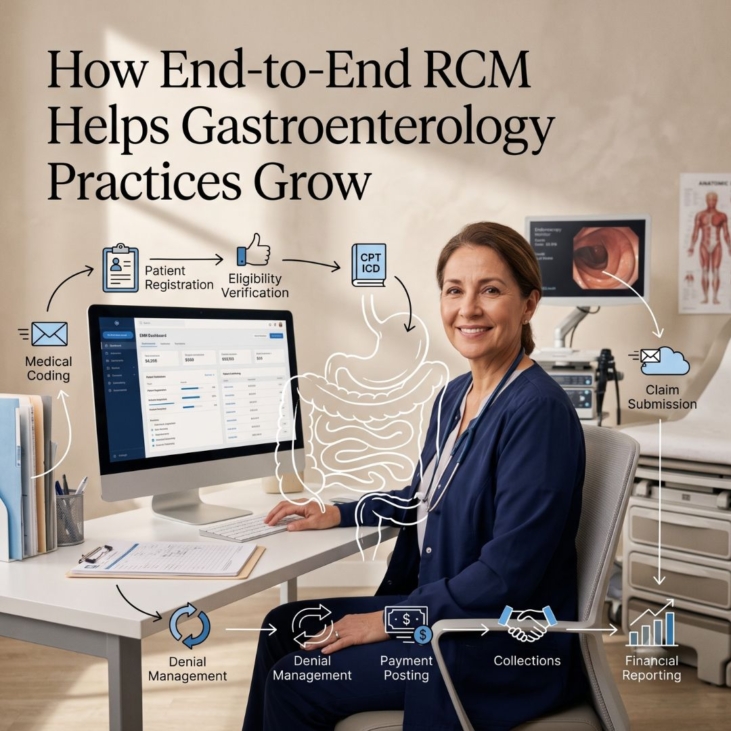
Gastroenterology practices perform complex procedures, diagnostic services, and treatment regimens that require accurate documentation, specialty-specific coding, and an efficient billing process. Procedures such as colonoscopies, endoscopies, biopsies and digestive health treatments have detailed revenue cycle requirements. Managing these processes manually can put you at risk for claim denial, delayed payments and administrative headaches. End-to-end Revenue Cycle Management (RCM) solutions help gastroenterology practices streamline every step of the billing process, boost collections and lay a stronger foundation for long-term success.
Improving Gastroenterology Billing Accuracy
Gastroenterology billing requires specialized knowledge as each procedure has unique coding guidelines and payer demands. Errors in procedure codes, diagnosis codes, modifiers or documentation can result in payment delays and rejection of the claim. End-to-end RCM services provide experienced billing and coding support to ensure claims are accurate, complete, and compliant with healthcare regulations, helping practices improve reimbursement outcomes.
Reducing Claim Denials and Revenue Loss
Claim denials may significantly affect the financial performance of gastroenterology practices. Typical reasons are bad coding, missing documentation, problems with eligibility or authorization. End-to-end RCM solutions analyze denial patterns, identify the root causes, and implement corrective actions to prevent the same issues from occurring again. This helps practices recover lost revenue and keep cash flow healthier.
Streamlining Insurance Verification and Authorization
Most gastroenterology procedures require insurance verification and prior authorization prior to treatment. These processes are subject to delays or errors which can create unnecessary claim issues. End-to-end RCM teams assist with eligibility checks, benefit verification, and authorization tracking to make sure all the necessary information is in place before services are provided. This increases workflow efficiency and decreases avoidable billing issues.
Enhancing Accounts Receivable Management
Gastroenterology practices’ growth can be impacted by unpaid claims and delayed reimbursements. Good accounts receivable management helps you track outstanding payments, follow up with payers, and resolve pending claims efficiently. End-to-end RCM services offer systematic AR management strategies that improve collections, allowing practices to benefit from a consistent revenue stream.
Using Technology to Improve Revenue Performance
Technology is an important part of today’s RCM operations. Automated tools can help in tracking claims, monitoring payments, analyzing denials, and generating financial reports. End-to-end RCM solutions employ technology to increase visibility into revenue cycle performance, decrease manual workload and aid practices in finding areas for improvement.
Reducing Administrative Burden for Healthcare Teams
Doing the billing operations in-house is time consuming and resource intensive. Gastroenterology teams are often asked to balance complex administrative tasks with patient care. End-to-end RCM services can help you manage key revenue cycle processes, so your physicians and staff can spend more time on patient care and increase operational efficiency.
Supporting Practice Growth Through Better Insights
You need to see how you’re doing financially to grow. End-to-end RCM solutions generate reports and analytics for collections, claim status, denial trends and reimbursement patterns. These insights allow gastroenterology practices to understand their revenue cycle performance and make informed decisions to improve efficiency and profitability.
Conclusion
End-to-end RCM services can help gastroenterology practices navigate complex billing challenges and build a more efficient revenue cycle. RCM helps practices improve their financial performance by improving coding accuracy, reducing claim denials, optimizing collections and leveraging technology-driven solutions. With improved revenue management, gastroenterology providers can spend less time on revenue cycle management and more time delivering quality patient care, while building a foundation for long-term growth.
Frequently Asked Questions
Q1. Why do gastroenterology practices need specialized RCM services?
Gastroenterology practices need specialized RCM services because GI procedures involve complex coding, documentation requirements, and payer guidelines that require specialty expertise.
Q2. How does end-to-end RCM improve gastroenterology revenue?
End-to-end RCM improves revenue by reducing billing errors, preventing claim denials, improving collections, and streamlining reimbursement processes.
Q3. What challenges can RCM solve for gastroenterology practices?
RCM helps solve challenges related to coding accuracy, insurance verification, authorization delays, denied claims, and delayed payments.
Q4. How does automation help gastroenterology billing?
Automation improves billing efficiency by helping with claim tracking, payment updates, reporting, and identifying potential revenue cycle issues.
Q5. Can outsourcing RCM help GI practices grow?
Yes, outsourcing RCM provides access to specialized expertise, advanced technology, and efficient billing processes that support practice growth.