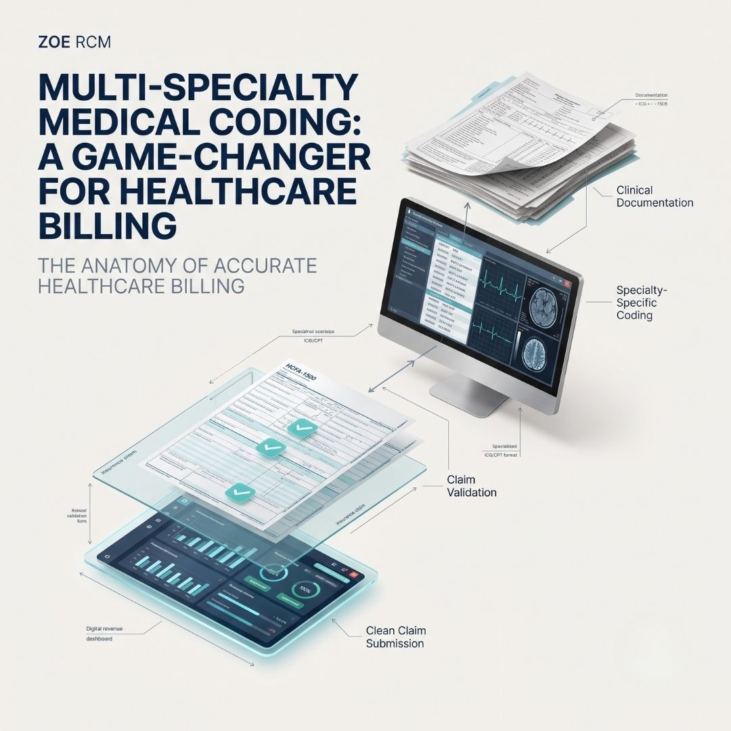
Multi-specialty medical coding is a paradigm shift in healthcare billing, helping hospitals, clinics and medical practices manage the different coding requirements accurately and efficiently. Different medical specialties have different documentation and coding guidelines, which increases the complexity for healthcare organizations that have multiple services that are billed. Specialized coding support helps to reduce preventable errors and improves accuracy of insurance claims and delays in reimbursement. Experienced coding professionals and structured workflows can help healthcare providers streamline their billing operations and enhance their revenue cycle management.
Understanding Multi-Specialty Medical Coding
Multi-specialty medical coding involves applying standard medical codes to diagnoses, procedures, and healthcare services in different medical specialties. These codes are used for insurance claims, billing and health care documentation. Different specialties have their own coding requirements . For example, cardiology, orthopedics, dermatology, radiology. Professionals trained in this field should know the applicable guidelines . Correct coding is the key to accurately representing healthcare services in the billing process.
Improving Medical Billing Accuracy
One of the biggest advantages of multi-specialty medical coding is billing accuracy. Incorrect diagnosis or procedure codes can lead to rejected claims, delayed payments, and additional administrative work. Medical coders review clinical documentation and specialize and apply proper coding guidelines to facilitate accurate claim preparation. This cuts down on avoidable errors and helps healthcare organizations keep more dependable billing records.
Reducing Insurance Claim Denials
Denials of insurance claims are a frequent problem for medical professionals who oversee several specialities. Inaccurate coding, missing paperwork, or inconsistent medical information may result in the denial of claims. Before claims are filed, coding-related problems can be found with the aid of multispecialty coding knowledge. Healthcare organisations can cut down on avoidable denials and the time required to amend rejected claims by increasing coding accuracy and documentation reviews.
Managing Complex Coding Requirements
Knowledge of particular procedures, therapies, and coding guidelines is necessary for many medical specialities. An orthopaedic claim might include surgery or fracture treatment, whereas a cardiology claim might comprise cardiovascular operations and diagnostic testing. Medical coding experts with many specialities are aware of these variations and use pertinent coding guidelines. This enables healthcare organisations to handle intricate billing requirements without depending on a single standard coding method.
Improving Revenue Cycle Management
Because it links clinical documentation with insurance billing, medical coding is crucial to the revenue cycle. Errors in coding can impede the processing of claims and cause reimbursement delays. Cleaner claim submissions, fewer unnecessary revisions, and better-organized financial operations are all supported by accurate multi-specialty coding. It can assist healthcare providers in increasing overall revenue cycle efficiency when paired with claims management and payment follow-ups.
Reducing Administrative Workload
Internal billing teams may be under a lot of strain to manage coding requirements across multiple medical departments. Employees may have to spend more time going over paperwork, fixing coding errors, and answering insurance-related questions. More efficient distribution of these duties is made possible by specialised medical coding assistance. As a result, healthcare organisations can cut down on tedious administrative tasks and free up more time for their staff to concentrate on crucial operational tasks.
Supporting Different Healthcare Specialties
Cardiology, neurology, orthopaedics, dermatology, and general medicine are just a few of the disciplines that hospitals and multispecialty clinics frequently offer services throughout. Different documentation standards and coding expertise may be needed by each department. Through specialised knowledge, multi-specialty medical coding services assist organisations in managing these differences. This is especially helpful for expanding medical practices that deal with a variety of patient procedures and treatments.
Using AI and Automation in Medical Coding
Automation and artificial intelligence are becoming more and more helpful in healthcare coding processes. AI-assisted technologies can point out potential coding discrepancies for review, discover missing documentation, and recommend potential codes. Additionally, workflow management and routine validation can be supported by automation. Nonetheless, skilled medical coders are still necessary for evaluating complicated cases, verifying coding accuracy, and upholding adherence to relevant regulations.
How ZOE RCM Supports Multi-Specialty Medical Coding
ZOE RCM’s healthcare revenue cycle management services include multispecialty medical coding. Its coding support aims to enhance billing processes and assist healthcare companies in managing various specialist requirements. Specialized coding can facilitate a more structured revenue cycle when combined with rejection management, payment posting services, and claims billing. These services can be assessed by healthcare providers based on their operating requirements, specializations, and coding volume.
Real-Life Example: Medical Coding in a Multi-Specialty Clinic
Think about a multispecialty clinic that provides orthopedic, dermatological, and cardiac services. Because each specialty has separate criteria, its billing team often has to make coding modifications while processing claims from all three departments. The clinic could find mistakes earlier and cut down on needless claim resubmissions by implementing a systematic documentation review process and hiring coding experts with specialized training. This example shows how multi-specialty coding can facilitate more effective reimbursement workflows and streamline billing operations.
Improving Healthcare Billing Compliance
Medical coding must adhere to healthcare rules, payer criteria, and appropriate coding standards. Inaccurate coding might raise compliance risks and lead to reimbursement issues. Healthcare businesses can maintain uniform documentation processes and apply pertinent coding principles with the assistance of multispecialty coding professionals. Maintaining current code sets and billing standards also requires regular coding reviews and continuous training.
Supporting Long-Term Healthcare Business Growth
Medical coding gets more complicated as healthcare companies grow. There are more coding and billing obligations when new specialties, providers, or treatment methods are added. Support for multispecialty medical coding can assist businesses in handling these transitions without unduly taxing current teams. Scalable coding enhances operational effectiveness and gets healthcare companies ready for rising claim volumes.
Conclusion
Multi-specialty medical coding plays an important role in making healthcare billing more accurate, organized, and efficient. By addressing specialty-specific coding requirements, healthcare providers can reduce preventable claim denials, simplify administrative work, and improve revenue cycle management.
ZOE RCM’s multi-specialty medical coding services offer healthcare organizations an option for managing complex coding requirements alongside other revenue cycle activities.
Frequently Asked Questions
Q1. What is multi-specialty medical coding?
Multi-specialty medical coding is the process of assigning standardized diagnosis and procedure codes to healthcare services across different medical specialties. It helps healthcare providers prepare accurate insurance claims and maintain organized billing records.
Q2. Why is multi-specialty medical coding important for healthcare billing?
Multi-specialty medical coding helps healthcare organizations manage different coding requirements, reduce preventable billing errors, improve claim accuracy, and support efficient reimbursement processes.
Q3. How does multi-specialty medical coding reduce claim denials?
Specialty-trained medical coders can identify incorrect codes, documentation gaps, and coding inconsistencies before claims are submitted. This helps reduce denials caused by avoidable coding errors.
Q4. Does ZOE RCM provide multi-specialty medical coding services?
Yes. ZOE RCM lists multi-specialty medical coding among its revenue cycle management services, supporting healthcare organizations with different medical coding requirements.
Q5. Can AI replace medical coders in multi-specialty healthcare billing?
AI can assist with code suggestions, documentation checks, and identifying potential errors. However, trained medical coders remain important for interpreting complex clinical records, reviewing coding decisions, and ensuring compliance with coding guidelines.