
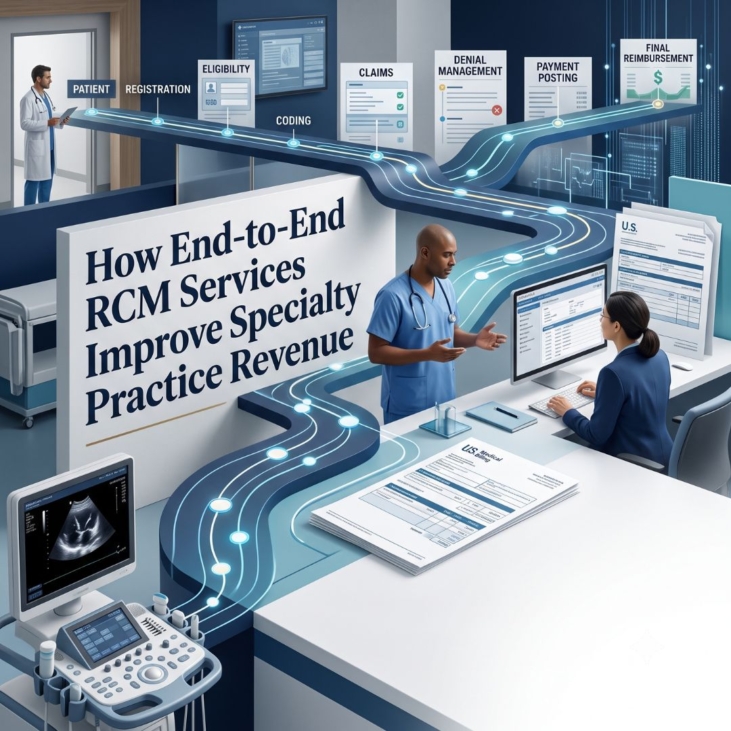
Specialty healthcare practices deal with intricate documentation, various insurance policies, sophisticated treatments, and unique coding needs. Manually handling these revenue cycle tasks can result in increased administrative responsibilities, delayed payments, invoicing problems, and claim denials. From patient registration and insurance verification to coding, claims, denial management, accounts receivable, and payment collection, end-to-end RCM services unify various procedures under a single organized system. As a result, specialist practices can increase revenue performance while spending less time with billing-related issues.
Managing the Complete Revenue Cycle
Rather than concentrating on specific billing tasks, end-to-end RCM services cover a patient account’s whole financial path. A linked process can handle registration, eligibility verification, coding, claim submission, payment posting, rejection management, and AR follow-up. This closes gaps between several processes and facilitates the identification of areas where revenue is lost or delayed.
Improving Specialty-Specific Coding Accuracy
Depending on the processes and services they offer, specialty practices frequently have certain coding requirements. Claims may be denied or underpaid because to mistakes in CPT codes, ICD-10 codes, modifiers, or paperwork. These standards are understood by specialized RCM teams, who check claims for accuracy before submitting them. Increased reimbursement and fewer preventable billing errors are two benefits of improved coding.
Reducing Claim Denials
Specialty practices’ revenue might be greatly impacted by claim denials. Inaccurate coding, inadequate paperwork, eligibility concerns, authorization issues, or payer-specific criteria can all result in denials. By determining the cause of rejection, fixing the problem, and contacting the payer again, end-to-end RCM services offer organized denial management. This lessens recurrent denial tendencies and helps recover unpaid revenue.
Improving Insurance Verification
Even before a claim is filed, issues relating to insurance might lead to financial difficulties. At the proper time, end-to-end RCM teams confirm patient eligibility, coverage, benefits, and other pertinent insurance information. Precise verification helps practices better understand possible payment obligations and lowers the likelihood of preventable claim rejections.
Streamlining Prior Authorization
Prior authorization is necessary for many specialty services and procedures. Manually handling authorization requirements raises the possibility of missed approvals and might cause delays. Authorization requests, necessary paperwork, approval status, and payer requirements can all be tracked with the aid of RCM services. Improved authorization management lowers authorization-related denials and facilitates more seamless billing.
Accelerating Accounts Receivable Collections
Practice revenue can be significantly impacted by outstanding accounts receivable. End-to-end RCM services identify aging accounts, keep an eye on unpaid claims, and promptly follow up with payers. Frequent AR management keeps claims from going unsettled for extended periods of time. Overall cash flow can be enhanced by collecting unpaid invoices more quickly.
Using Technology to Improve RCM Efficiency
Automation and technology are used in modern RCM services to streamline tedious billing tasks. Processing time can be increased and manual labor can be decreased with automated claim tracking, eligibility verification, payment posting, denial analysis, and reporting. Additionally, technology makes revenue cycle performance more visible, which enables practices to see issues faster.
Providing Better Revenue Cycle Visibility
Clear information on where revenue is being generated and where it is being delayed is necessary for specialty practices. Reports and performance insights encompassing indicators including denial rates, accounts receivable, payment turnaround, and collection performance are offered by end-to-end RCM services. Practice managers can find inefficiencies and make wise financial decisions with the aid of these insights.
Reducing Administrative Burden
It takes a lot of administrative work, skilled personnel, and ongoing payer updates to manage billing processes internally. By enabling specialist teams to handle intricate financial procedures, outsourcing end-to-end RCM operations helps lessen this burden. Patient care and other crucial operational duties can then receive more attention from practice staff.
Improving Overall Revenue Performance
Specialty practices have fewer revenue cycle gaps when registration, coding, claims, denials, AR, and payment collection are coordinated. Improved reimbursement schedules, decreased revenue leakage, and improved cash flow can all be achieved through better process coordination. A more structured and economical revenue cycle is the end outcome.
Conclusion
Specialty practices can handle the intricate billing and reimbursement issues that impact their financial performance with the aid of end-to-end RCM services. A comprehensive RCM solution enhances control over the revenue cycle through specialty-specific coding and rejection management, insurance verification, authorization, AR follow-up, and technology-driven workflows. Specialty practices can increase collections, lessen administrative strain, and provide a more effective route from patient care to payment by optimizing these procedures.
Frequently Asked Questions
1. What are end-to-end RCM services?
End-to-end RCM services manage the complete healthcare revenue cycle, including registration, insurance verification, coding, claims, payment posting, denial management, and accounts receivable.
2. How can RCM services increase specialty practice revenue?
RCM services can improve revenue by reducing billing errors and denials, accelerating claim processing, improving AR collections, and ensuring appropriate reimbursement.
3. Why do specialty practices need specialized RCM?
Specialty practices often have unique coding, documentation, authorization, and payer requirements. Specialized RCM teams understand these requirements and can manage them more effectively.
4. Can end-to-end RCM services reduce claim denials?
Yes. Proper coding, eligibility verification, documentation review, authorization management, and proactive denial handling can help reduce avoidable claim denials.
5. Does outsourcing RCM reduce administrative workload?
Yes. Outsourcing allows specialized RCM teams to handle complex billing and revenue cycle activities, reducing the workload on internal administrative staff.