
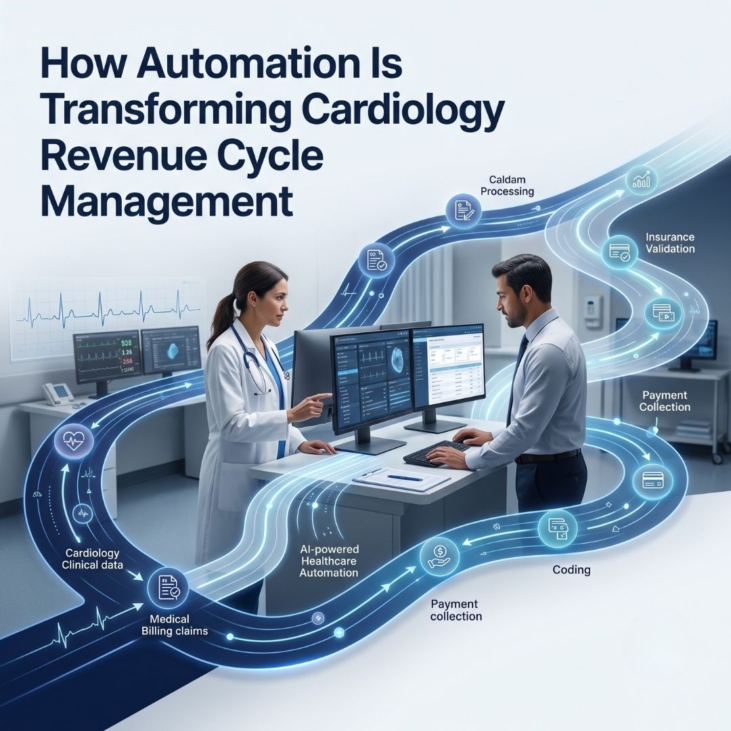
Automation is revolutionizing the revenue cycle management for cardiologists by making the billing operations faster, accurate and efficient. Cardiology practices perform complex procedures like cardiac imaging, catheterization, electrophysiology services, and chronic care management. These procedures require accurate coding and documentation. Manual billing processes are prone to errors, delays in claims and administrative challenges. The automation allows cardiology providers to improve workflows, increase claim accuracy, decrease denials and have a more robust revenue cycle, while giving healthcare teams more time for patient care.
Automated Medical Coding Improves Billing Accuracy
Cardiology billing is no different as it requires a thorough knowledge of CPT codes, ICD-10 codes, modifiers, and payer-specific guidelines. Manual coding errors can lead to claim rejection, payment delays or compliance issues. Automated coding solutions analyze clinical documentation and assist in assigning appropriate codes for services provided. This results in better billing accuracy, fewer human errors and ensures cardiology practices are adequately reimbursed for their services.
Automated Claim Processing Speeds Up Reimbursements
It also assists cardiology practices in improving the claim submission process by reviewing the claims before sending them to insurance providers. The automation systems can highlight missing information, wrong coding details, and even possible errors that may cause rejection. Clean claims submission results in higher approval rates and less reimbursement delays. Faster claims processing means better cash flow and improved financial stability.
Reducing Cardiology Claim Denials Through Automation
Denials are one of the biggest challenges in managing the cardiology revenue cycle. Common reasons for denial that can be flagged by automation include coding errors, insufficient documentation, authorization problems and payer-specific rules. Automated denial tracking systems analyze patterns in rejections and provide insights so that future mistakes can be avoided. This enables billing teams to fix issues faster and recoup lost revenue more effectively.
Streamlining Insurance Verification and Eligibility Checks
Insurance verification is an important step to avoid billing issues. Procedures in cardiology typically involve costly diagnostic tests and treatments, necessitating accurate coverage information. Automated eligibility verification tools quickly verify patient insurance, benefits and coverage requirements. This reduces manual effort, prevents unexpected claims issues and improves the overall patient billing experience.”
Improving Prior Authorization Management
Several cardiology procedures require prior authorization before treatment. Manual approval management can cause delays and missed requirements. Automation helps to track authorization requests, to monitor approval status and to ensure required documents are submitted on time. A simpler authorization process reduces procedural delays and claim denials due to missing approvals.
Enhancing Documentation Review
Cardiology Reimbursement Needs Complete and Accurate Documentation Automation tools can scan through medical records to point out missing information that is needed to support claims. These systems help to ensure proper documentation of diagnosis information, procedure notes and medical necessity requirements. Good documentation leads to better claim acceptance and lesser compliance risks.
Using Data Analytics for Better Revenue Decisions
Automation helps advanced analytics deliver critical information to cardiology practices about their revenue cycle. Automated systems can track denial trends, reimbursement patterns, payment timelines and accounts receivable performance. These insights inform practice managers about the challenges they face, improve workflows, and make data-driven decisions. Better visibility into revenue performance supports long-term financial growth.
Reducing Administrative Workload
Manual billing activities such as claim tracking, payment posting, follow-ups, and reporting require significant time and resources. Automation handles repetitive tasks more efficiently, allowing billing teams to focus on complex issues that need human expertise. Reduced administrative workload improves productivity and helps cardiology practices operate more efficiently.
Improving Compliance and Security
Healthcare billing must strictly comply with regulations and data protection standards. Automated RCM systems also help in maintaining accurate records, following billing activities and help in safe data management. Automation reduces manual errors and increases process consistency, enabling cardiology practices to meet compliance and reduce financial risk.
The Future of Automation in Cardiology RCM
The future of cardiology revenue cycle management will continue to trend toward intelligent automation powered by artificial intelligence, machine learning, and advanced analytics. These technologies will help practices predict claim issues, improve decision-making and create more personalized revenue strategies. As cardiology services grow more complex, automation will increasingly help improve efficiency and financial performance.
Conclusion
By increasing accuracy, lowering administrative difficulties, and speeding up reimbursement procedures, automation is transforming cardiology revenue cycle management. Technology makes it easier for cardiology practices to handle complicated billing requirements, from automated coding and claim processing to denial prevention and analytics. Cardiology providers can lower operating costs, increase revenue performance, and concentrate more on providing high-quality patient care by implementing automation solutions.
Frequently Asked Questions
1. How does automation improve cardiology revenue cycle management?
Automation improves cardiology RCM by streamlining billing processes, reducing errors, improving claim accuracy, and speeding up reimbursements.
2. Can automation reduce cardiology claim denials?
Yes, automation helps identify coding errors, missing documentation, authorization issues, and payer-related problems before claims are submitted.
3. What cardiology billing tasks can be automated?
Tasks such as insurance verification, coding assistance, claim processing, payment tracking, denial analysis, and reporting can be automated.
4. How does automation benefit cardiology billing teams?
Automation reduces repetitive manual tasks, improves productivity, and allows billing teams to focus on complex revenue cycle challenges.
5. Will automation replace medical billing professionals?
Automation will not replace billing professionals but will support them by improving efficiency and allowing them to focus on decision-making and complex billing activities.