
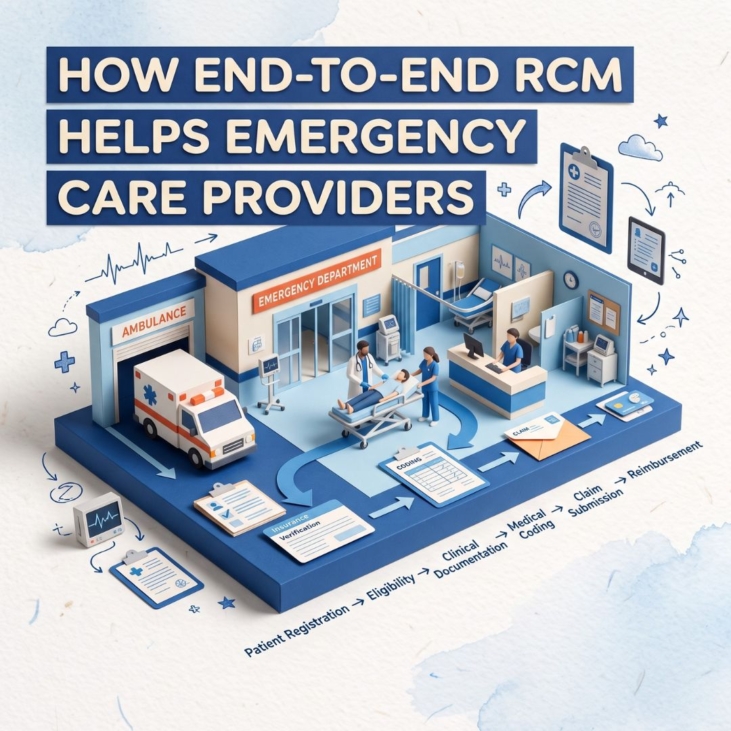
Emergency care providers work in a fast-paced environment where patient care is a priority, but effective revenue cycle management is also vital to financial health. Emergency departments are under pressure from unpredictable patient volumes, complex treatments, multiple insurance requirements, and time-sensitive billing processes. End-to-end Revenue Cycle Management (RCM) enables emergency care providers to handle the entire billing process, including patient registration, insurance verification, coding, claim submission, collection of payments and denial management. A structured RCM approach improves revenue accuracy without taking emergency teams away from the work of caring for patients in immediate need.
Streamlining Patient Registration and Data Management
The arrival of patients without prior appointments to emergency departments complicates the process of registration. Missing or incorrect patient information can lead to delays in claims and reimbursement issues. End-to-end RCM ensures the patient details, insurance information, and required documentation are captured accurately at the very beginning of the process. It provides a strong base for accurate billing and minimizes administrative errors.
Improving Emergency Medical Coding Accuracy
Billing for emergency care is complex due to the variety of services provided, which depend on patient conditions, procedures involved, medical evaluations, and treatment intensity. Coding errors can lead to claim denials, underpayments, or compliance issues. Specialized RCM teams review clinical documentation, apply proper billing guidelines and ensure accurate CPT and ICD-10 coding. It increases reimbursement accuracy and reduces coding challenges.
Reducing Claim Denials in Emergency Billing
Emergency care providers worry about denials because they directly impact revenue and cash flow. The most common reasons for denial are incomplete documentation, incorrect coding, eligibility problems and missing authorization information. End-to-end RCM is about identifying and correcting potential errors prior to claim submissions. Effective denials management can help you regain lost revenue and boost your overall claim approval rate.
Managing Insurance Verification and Eligibility Challenges
Patients with different insurance plans, coverage levels, and responsibility for payment come through emergency departments. Insurance eligibility verification can be complex, especially in emergency situations. RCM solutions assist in automating the insurance verification process and accurately capturing coverage details. This leads to fewer denied claims and helps providers better understand what is needed to get paid.
Handling Complex Emergency Documentation
Coverage of emergency care is contingent on adequate documentation, as medical records need to substantiate the services rendered. Emergency treatments often include multiple procedures, diagnostic tests and urgent interventions. End-to-end RCM means that the documentation is reviewed properly for medical necessity and claims are submitted accurately. This will help ensure compliance and reduce delays in payment.
Faster Claims Processing and Reimbursement
Emergency care providers require efficient claim processing because delays can impact their financial performance. End-to-end RCM accelerates the claims submission process by minimizing errors, automating workflows, and ensuring claims are filed correctly the first time. The faster processing will help providers get paid sooner, and have better cash flow.
Effective Accounts Receivable Management
Emergency rooms face significant challenges in managing outstanding claims because of their large patient numbers and intricate billing scenarios. Regular claim follow-ups, payment tracking, and accounts receivable analysis are all part of end-to-end RCM. This lowers the amount of aging claims, finds late payments, and collects unpaid revenue.
Using Technology to Improve Emergency RCM
In today’s emergency care revenue cycle management, technology is crucial. Error detection, claim tracking, and workflow efficiency are all enhanced by automated billing systems, analytics platforms, and AI-based solutions. Technology improves financial performance visibility and minimizes manual labor. Accurate revenue cycle data allows emergency providers to make choices more quickly.
Reducing Administrative Burden on Healthcare Teams
Instead of devoting too much time to handling billing concerns, emergency physicians and medical personnel should concentrate on patient care. Complex administrative duties like coding, claims processing, denial follow-up, and payment administration are handled by end-to-end RCM. As a result, emergency teams have less work to do and can operate more effectively.
Ensuring Compliance and Revenue Protection
Billing for emergency care must adhere to compliance requirements, payer rules, and healthcare legislation. Inaccurate billing procedures may result in audits, fines, and monetary losses. Thru precise coding, documentation review, and revised billing procedures, end-to-end RCM services aid in maintaining compliance. This promotes moral healthcare practices while safeguarding profits.
Conclusion
End-to-end RCM helps emergency care providers overcome complex billing challenges by improving accuracy, reducing claim denials, speeding up reimbursements, and simplifying financial operations. From patient registration to final payment collection, every stage of the revenue cycle is managed efficiently. With specialized RCM support, emergency departments can improve financial performance while focusing on their primary goal of providing timely and quality patient care.
Frequently Asked Questions
1. What is end-to-end RCM in emergency care?
End-to-end RCM is a complete revenue cycle solution that manages emergency billing processes from patient registration and coding to claims, payments, and denial management.
2. Why do emergency departments need specialized RCM services?
Emergency departments handle complex treatments, high patient volumes, and urgent billing requirements that require specialized revenue cycle expertise.
3. How does RCM reduce emergency care claim denials?
RCM reduces denials through accurate coding, documentation review, eligibility verification, claim auditing, and proactive denial management.
4. How does technology improve emergency department billing?
Technology improves billing by automating workflows, tracking claims, identifying errors, and providing financial insights for better decision-making.
5. What are the benefits of outsourcing emergency care RCM?
Outsourcing RCM helps emergency providers reduce administrative workload, improve reimbursements, maintain compliance, and focus more on patient care.