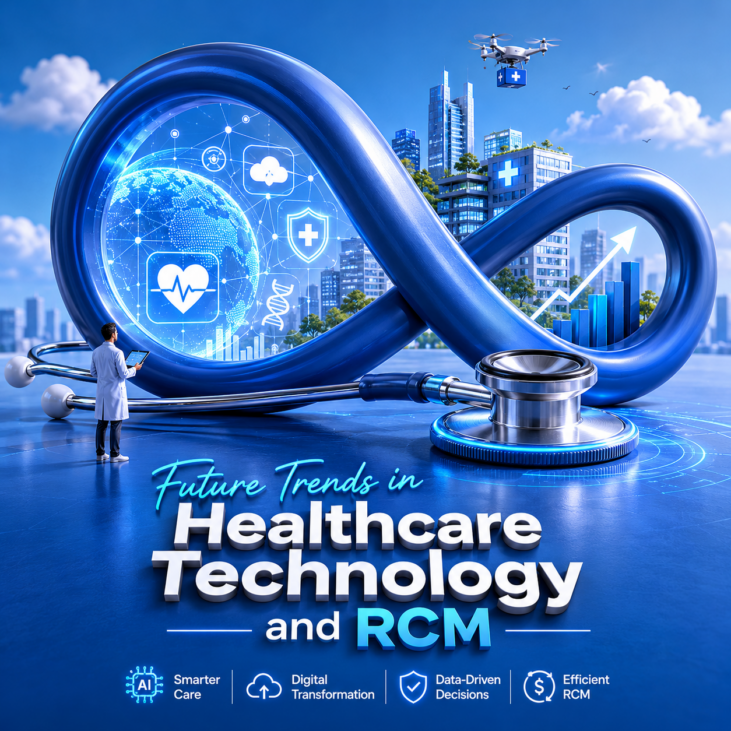
The healthcare industry is going through a rapid digital transformation and technology is playing a big part in shaping healthcare operations and financial management. Revenue Cycle Management (RCM) is also evolving with advanced digital tools and automation technologies for managing financial processes of healthcare organizations. From artificial intelligence and predictive analytics to cloud-based systems and telemedicine, healthcare providers are increasingly tapping into smarter solutions to enhance patient care, boost operational efficiency and improve financial performance.
As the demands from patients, regulatory requirements and financial challenges continue to increase for healthcare organizations, modern healthcare technology and RCM solutions are becoming more important than ever. This blog will talk about the future trends that will change healthcare technology and Revenue Cycle Management.
Artificial Intelligence and Automation in Healthcare
Artificial Intelligence (AI) is becoming one of the most important technologies in the healthcare of today. Systems powered by AI help healthcare providers automate repetitive tasks, analyze patient data, improve the accuracy of diagnosis, and optimize healthcare operations.
AI is assisting to automate medical billing, coding, claim verification and denial management processes in Revenue Cycle Management. Automation can help identify billing errors, reduce claim denials and improve reimbursement accuracy. This not only increases operational efficiency but also helps healthcare organizations to increase revenue and reduce administrative workloads.
AI chatbots and virtual assistants are also improving patient engagement by managing appointment scheduling, responding to common patient inquiries, and sending payment reminders.
Cloud-Based Healthcare and RCM Solutions
Cloud computing is revolutionizing the way healthcare organizations manage patient records and financial operations. With cloud-based healthcare systems, providers can store and access data safely from anywhere, which enhances the flexibility and collaboration between departments.
Cloud-based RCM solutions simplify billing, payment tracking, insurance verification and financial reporting . Health care providers no longer need costly physical servers or complex IT infrastructure, making cloud technology cheaper and more scalable.
Access from anywhere, sharing of data and real-time management of operations through secure cloud systems will increasingly shape the future of healthcare management.
Predictive Analytics for Better Decision-Making
Predictive analytics is enabling faster and smarter decision making for healthcare organizations. Predictive tools use massive patient and operational data to identify healthcare trends, predict patient risks and improve resource planning.
Predictive analytics in RCM helps healthcare providers forecast revenue, identify payment delays, reduce claim denials, and improve financial performance. Healthcare organizations can also leverage predictive models to optimize staffing, manage patient flow and improve treatment outcomes.
As health care data continues to grow, predictive analytics will become even more important in improving both clinical and financial decision-making.
Telemedicine and Remote Patient Management
Telemedicine is one of the fastest growing trends in healthcare technology. Digital healthcare services, such as remote monitoring and virtual consultations, are making healthcare more accessible and convenient for patients.
Healthcare organizations are combining telemedicine with RCM systems to make billing, digital payments, insurance claims and patient communication more efficient. Remote healthcare solutions enable healthcare providers to better manage appointments, prescriptions and follow-ups.
The future of healthcare delivery will likely incorporate telemedicine and remote health care technologies as a standard of care, particularly in rural and underserved areas.
Electronic Health Records and Interoperability
Electronic Health Records (EHR) are still evolving with intelligent features and better system integration. Modern healthcare systems emphasize interoperability, which allows patient information to be shared seamlessly between different healthcare platforms and departments.
Better interoperability allows doctors, hospitals, laboratories and insurance providers to communicate more effectively. It removes delays, improves accuracy of diagnosis and helps better coordination of patient care.
Future healthcare systems will focus on connected healthcare ecosystems with real-time access to patient information from multiple platforms.
Cybersecurity and Data Protection
Cybersecurity has become a top priority for healthcare organizations adopting digital technologies. Healthcare systems are susceptible to cyberattacks because they contain extremely sensitive patient and financial information.
In the future, healthcare technology and RCM systems will be more secure with advanced encryption, multi-factor authentication, and AI-based threat detection. Healthcare organizations will continue to make protecting patient data and meeting regulatory requirements a top priority.
Healthcare providers will be expected to make significant investments in cybersecurity infrastructure to protect the safe and secure delivery of digital healthcare.
Patient-Centered Digital Experiences
Modern patients want an easy personalized healthcare experience. Future healthcare systems are placing greater emphasis on patient engagement via digital platforms, mobile apps and self-service portals.
Integrated healthcare systems allow patients to book appointments, access their medical records, get digital prescriptions and make payments online. RCM platforms are also improving transparency by helping patients see billing information and insurance coverage more clearly.
The future of healthcare technology will continue to focus on making care more convenient, accessible and communicative for patients.
Conclusion
The future of healthcare technology and Revenue Cycle Management is powered by innovation, automation and digital transformation. AI, cloud computing, predictive analytics, telemedicine, and advanced cybersecurity are transforming healthcare operations and financial management.
Healthcare organizations that take advantage of these future trends will be better positioned to improve patient care, streamline operations, lower costs and improve financial performance. With the development of technology, the modern healthcare systems will be smarter, faster and more patient-focused, resulting in the more efficient and connected healthcare industry.
FAQs
1. What is Revenue Cycle Management (RCM)?
RCM is the process of managing the financial operations of healthcare organizations, including billing, claims processing, payment collection, and revenue tracking.
2. How is AI changing healthcare and RCM?
AI helps automate administrative tasks, improve billing accuracy, reduce claim denials, and support faster healthcare decision-making.
3. Why are cloud-based healthcare systems important?
Cloud systems provide secure remote access to healthcare data, improve collaboration, reduce infrastructure costs, and support scalable healthcare operations.
4. What role does predictive analytics play in healthcare?
Predictive analytics helps healthcare providers forecast trends, improve patient care, optimize resources, and enhance financial planning.
5. How does telemedicine impact healthcare operations?
Telemedicine improves healthcare accessibility, supports remote patient care, and simplifies digital healthcare management and billing processes.